Poisoned Promises: Middlemarch's Serial Advertisements and Victorian Anxieties of Trust
By Fatin Abou-Hussein
In the original serial publication of Middlemarch, advertisements formed an integral part of the reading experience rather than mere commercial intrusions. As Kate Flint argues in “The Materiality of Middlemarch,” reading is fundamentally physical, entailing "a particular individual's engagement with a particular object in a specific space or sequence of spaces" (65). Victorian readers thus encountered Eliot's fiction literally sandwiched between ads for products such as patent plasters, hair restorers and cough lozenges. These ads were aimed at people who were anxious about their bodies and eager to improve or adorn them (Flint 66). Flint's analysis reveals how such material surroundings actively shape perception: objects register "the processes of social history that underpin the world of the text," influencing readers' emotional responses even when the narrator remains silent about them (66). Far from interrupting the novel, these ads belong to its semantic field, amplifying the novel’s central anxieties about medicine, trust, and the substances we consume. While scholars have long examined Middlemarch’s treatment of medicine, the serial advertisements add a dimension that operates below the level of conscious interpretation: they celebrate the promised benefits of drugs and patent remedies while participating in the same cultural anxiety the novel dramatizes, the fear that the ordinary substances of daily life might conceal poison rather than cure, and that the hand administering them might be the one most trusted. By examining the language of these ads, my research considers how their word choices respond to the ongoing poison scare in England during the years of Middlemarch’s serialization, when a rise in poisoning cases unsettled public confidence in medicine and domestic safety alike. In tracing these connections, I argue that the advertisements do not merely reflect the novel’s concerns but intensify them, participating in a broader cultural conversation about vulnerability, trust, and the uncertain boundaries between cure and harm.
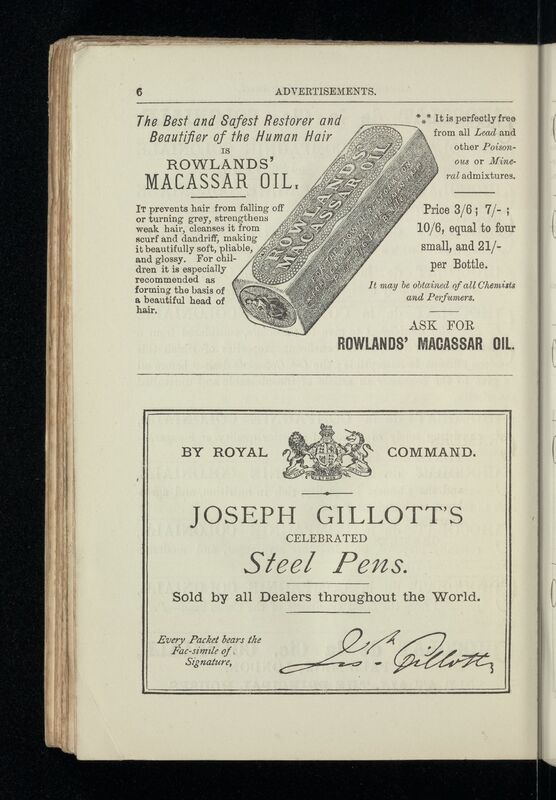
Nowhere is this tension sharper than in Book VII, "Two Temptations". Eliot presents Lydgate as a principled young doctor who repeatedly cautions against overprescribing. He practices strict "abstinence from drugs" and gives the dying Raffles only "extremely moderate doses of opium" (Eliot 307, 447). Yet Bulstrode's deliberate silence, his failure to tell Mrs. Abel when the doses should cease, turns that medical act into a fatal one (Eliot 480). The very page that concludes the book confronts the reader with a prominent advertisement for “ROWLANDS' MACASSAR OIL,” which proudly declares the product "perfectly free from all Lead and other Poisonous or Mineral admixtures,” a reassurance aimed at customers who feared toxic metals in the very items meant to restore health or beauty.
To understand why that reassurance carried such weight for Victorian readers, it is necessary to recover the specific cultural panic it was answering—one legible in my archival research on the Old Bailey records. On 13 December 1847, roughly twenty-four years before Eliot published the first book of Middlemarch, a twelve-year-old boy named William Newton Allnutt poisoned his seventy-four-year-old grandfather, Samuel Nelme, by stirring a massive dose of arsenic (over half an ounce taken from the household rat poison) into the family sugar basin (trial t18471213-290). As Joel Eigen notes in “Lesion of the Will: Medical Resolve and Criminal Responsibility in Victorian Insanity Trials,” the Allnutt case was among those that "revealed the defining elements of moral insanity to the medical witnesses" in British law, and its proceedings were extraordinary by the standards of the time (448). Where earlier trials involving juvenile defendants typically amounted to a few lines recording crime and outcome, the Allnutt record extends across detailed medical testimony and a searching examination of culpability itself (trial t18471213-290). What lodged in the public consciousness was not only the boy's age but the mechanism: poison hidden in sugar, administered by a family member, indistinguishable from the ordinary substance of daily domestic life until it was too late (trial t18471213-290).
This was not an isolated case but the most visible symptom of a wider crisis. As Katherine Watson documents, of 563 criminal poisoning trials recorded between 1720 to 1914, 49 percent occurred in the forty‑five‑year window between 1815 to 1860, the very decades of Eliot’s own formation as a writer (Watson 37). For readers who encountered Middlemarch in its original serial parts, poison was not a gothic import from the past. It was a lived social reality, and the Allnutt case had crystallized its most disturbing feature: the threat did not come from strangers or visible enemies, but from trusted hands, familiar substances, and the unremarkable routines of the household. It is precisely this fear that the Rowlands advertisement addresses and that the Bulstrode plot has just restaged. In a critical scene in Book VII, Bulstrode does not poison Raffles directly; he withdraws information and silently enables the fatal mistake:
Mr. Bulstrode did not answer. A struggle was going on within him. “I think he must die for want o’ support, … It’s not a time to spare when people are at death’s door.” … Here a key was thrust through the inch of doorway, and Mr. Bulstrode said huskily, “That is the key of the wine-cooler. You will find plenty of brandy there.” (480)
He has already received Lydgate’s explicit orders for measured opium doses at precise intervals and no alcohol (477). By handing over the wine-cooler key to the trusted Mrs. Abel without a word of correction, Bulstrode lets the ordinary machinery of domestic medical care, administered by familiar hands in the routine of the sickroom, do the rest. The result is the wrong substance at the wrong interval worsened by the familiarity of alcohol, exactly as the Victorian reader’s deepest household anxieties had been primed to fear. The Allnutt case had taught Victorian readers that poison did not announce itself, but hid in sugar basins, in familiar hands, in the substances of everyday life. The advertisement’s insistence that its product contains no hidden poisons lands directly inside that fear.

At the end of Book VII, Middlemarch places the reader beside another advertisement, this time for “ALLCOCK’S POROUS STRENGTHENING PLASTER,” which announces that “[t]he public are informed these plasters have been established 27 years”. More significant, however, is the ad’s large heading “TESTIMONIALS” which frames the product not through abstract claims but through the authority of personal witness. In the testimonial on the right-hand side, the speaker writes: “My dear Sir,—Please forward me some Brandreth’s Pills and Porous Plasters To the amount of enclosure. I may here state I have been in the habit, for the last 37 years, of administering these remedies to the sick with great success.” The advertisement thus depends on the persuasive force of an individual endorsement, one that seeks to convert private experience into public confidence. What makes this especially significant is that the testimonial does not merely assert the product’s value; it models how trust is socially produced, since the reader is encouraged to believe the remedy because someone else has already used it and vouched for it. In this sense, the ad functions through the same logic Flint identifies in Middlemarch, where influence spreads outward through a network of social interactions rather than remaining confined to a single source (84-85). As Flint argues, Dorothea’s effect on those around her is “incalculably diffusive”, a phrase that names not only moral influence but the wider circulation of feeling and belief through a network of social relations (84). The testimonial in the ad works similarly: it transforms one person’s experience into a broader mechanism of persuasion, suggesting that credibility grows when an individual endorsement enters circulation and becomes available to a larger public.
This logic finds its clearest expression in the final lines of Book VII, where Dorothea declares in Lydgate's defense: "You don't believe that Mr. Lydgate is guilty of anything base? I will not believe it. Let us find out the truth and clear him!" (Eliot 494). The declaration is personal and fierce, but its structure is recognizable: one person staking their credibility on another's character, and betting that conviction is contagious. The Allcock's advertisement operates on exactly the same premise. Its testimonials do not prove the plaster works; they demonstrate that people of standing have said so, and that saying so publicly is itself a form of social action. Flint helps illuminate why this parallel carries such weight. She argues that in Middlemarch, no individual is self-contained: what we feel, believe, and perceive is shaped by those around us, and our own responses in turn shape others, rippling outward through social networks in ways we rarely notice and cannot fully control (Flint 82-83). Dorothea's campaign in Book VIII is a conscious mobilization of exactly this process. She pledges to bring Mr. Brooke, Sir James Chettam, and Mr. Farebrother to Lydgate's cause, and insists that even those who barely know her "would believe me" if she spoke for him (Eliot 514). She understands that trust travels along social bonds rather than residing in any single authority. The Allcock's advertisement understands this too. Both convert individual conviction into collective credibility, and in doing so they reveal something the novel and its commercial surroundings share: that in Victorian society, whether one is selling a remedy or defending a reputation, trust is never a private matter. It is always, and only, a social one.
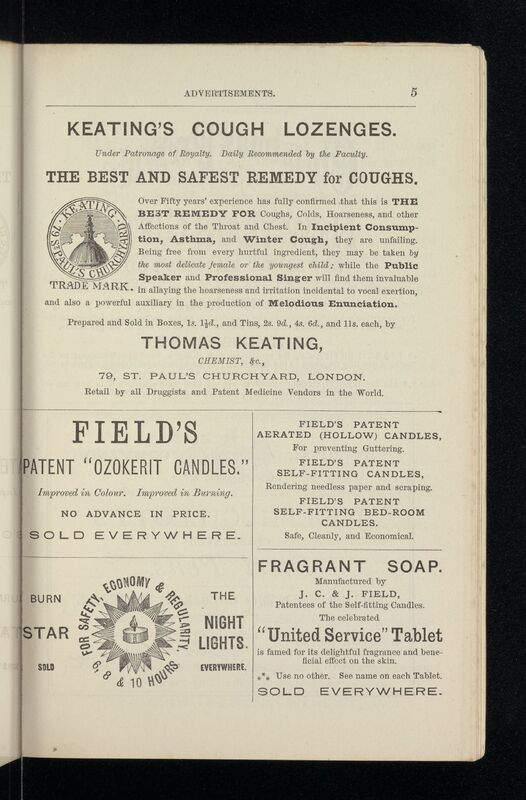
A similar dynamic emerges in the advertisement that closes Book VIII, "Sunset and Sunrise", but with a crucial formal difference that marks an endpoint rather than a continuation. "KEATING'S COUGH LOZENGES" declares itself "THE BEST AND SAFEST REMEDY for COUGHS" and reassures buyers that its lozenges are "free from every hurtful ingredient" and safe for "the most delicate female or the youngest child". The earlier advertisements we have examined responded to anxieties the novel had just raised: Rowlands' oil declared its non-toxicity immediately after Raffles died, and Allcock's testimonials performed social trust at precisely the moment Dorothea was learning to mobilize it. Keating's advertisement does something more unsettling. It arrives after the novel's moral reckoning is complete, after guilt has been established and reputations destroyed, and it speaks as though none of it happened. The advertisement acknowledges these concerns only in passing, unwilling to linger. The language does not simply promise efficacy; it declares innocence in a world the novel has just shown to be irreversibly compromised. What the earlier ads registered as anxiety, this one registers as willed amnesia.
Flint argues that the material world in Middlemarch is never passive backdrop, that objects actively shape "the perceptual and emotional habits and responses of those who own, wear, desire, observe, or dispose of them" (66). Applied here, her framework reveals something the novel's famous finale cannot quite say directly: that the Victorian marketplace did not absorb the lessons of the Bulstrode scandal but simply moved on, regenerating the same promises on the same terms. A remedy that must advertise its freedom from harmful ingredients is not selling confidence in medicine. It is responding to the erosion of it, and then asking the reader to forget that erosion ever occurred. Positioned at the end of the serial, Keating’s advertisement exemplifies the cultural pattern Eliot exposes throughout: systems of trust renew themselves not by confronting their breakdowns but by covering them with new layers of reassurance.
This is where the advertisement's address to "the most delicate female" and "the youngest child" becomes most precisely legible. By the novel's end, Lydgate has surrendered his reforming ideals, left Middlemarch, and built the fashionable practice he once despised, becoming what Eliot states "what is called a successful man" and, crucially, the father of daughters (560). The advertisement's assurance of safety for the vulnerable invites the reader to imagine Lydgate in exactly this later life: a physician-father with “an excellent practice,” prescribing remedies to his children, his earlier catastrophe invisible to them and to his new patients (Eliot 560). Keating's ad extends this logic beyond the individual: it shapes what the culture permits itself to remember. Lydgate was destroyed not by any wrongdoing of his own, but because he could not see the corruption hiding beneath the ordinary routines of professional life. Keating's advertisement, appearing on the first page after the novel's final book, reproduces that same reassuring surface (calm, competent, trustworthy) as if nothing had ever gone wrong beneath it. This is the serial form's deepest irony: the very format that made Middlemarch so culturally powerful also allowed it to close beside exactly the kind of promise the novel had spent eight books carefully, systematically proving false.
The three advertisements examined here do more than sit beside Middlemarch; they extend its argument in ways the novel itself cannot. Eliot exposes how trust is made, exploited, and broken, but the serial form ensures she never has the final word. Rowlands’ oil asserts its safety over Raffles’s body; Allcock’s testimonials perform credibility just as Dorothea learns to wield it; and Keating’s lozenges arrive after the moral reckoning, speaking as though nothing has happened. This is not incidental but structural: a marketplace plot running alongside Eliot’s and ultimately outlasting it. What this exhibit reveals is that Victorian readers never encountered Middlemarch’s critique of trust in isolation. They encountered it alongside the very commercial language that made such trust possible. The advertisements did not wait for Eliot to finish before answering her; they answered immediately, on the next page, repeating the same promises of purity and safety that Bulstrode’s fraud had already exposed as hollow. This is the serial form’s central irony: what enabled Middlemarch to circulate so widely also enabled its critique to be quickly absorbed and returned as reassurance. Eliot diagnosed the disease. The advertisements, quite literally, advertised the cure.
Works Cited
Allcock. "Allcock's Porous Strengthening Plaster." Middlemarch Edinburgh and London: William Blackwood & Sons, 1871, Vol. 7 of Middlemarch: Two Temptations. 8 vols. 1871-1872.
Eigen, Joel P. "Lesion of the Will: Medical Resolve and Criminal Responsibility in Victorian Insanity Trials." Law & Society Review, vol. 33, no. 2, 1999, pp. 425-59. JSTOR, https://doi.org/10.2307/3115170.
Eliot, George. Middlemarch. Edited by Ronjaunee Chatterjee, Norton Critical Edition, W. W. Norton & Company, 2024.
Flint, Kate. “The Materiality of Middlemarch.” Middlemarch in the Twenty-First Century, edited by Karen Chase, Oxford University Press, 2006, pp. 65-86.
Keating, Thomas. "Keating's Cough Lozenges." Middlemarch Edinburgh and London: William Blackwood & Sons, 1871, Vol. 8 of Middlemarch: Sunset and Sunrise. 8 vols. 1871-1872.
Old Bailey Proceedings Online (www.oldbaileyonline.org, version 9.0) December 1847, trial of William Newton Allnutt (t18471213-290).
Rowlands. "Rowlands' Macassar Oil." Middlemarch Edinburgh and London: William Blackwood & Sons, 1871, Vol. 7 of Middlemarch: Two Temptations. 8 vols. 1871-1872.
Watson, Katherine D. "Poisoning Crimes and Forensic Toxicology since the 18th Century." Academic Forensic Pathology, vol. 10, no. 1, 2020, pp. 35-46. PubMed Central, https://doi.org/10.1177/1925362120937923.