History at the Margins: Paratext, Minor Characters, and Distributed Realism in George Eliot’s Middlemarch.
George Eliot’s Middlemarch is often read as a self-contained, inward-facing masterpiece of Victorian realism. Yet the novel’s original serialised form complicates that assumption. Literary advertisements surrounding each of eight publications do not merely market other texts to idle readers between instalments. Instead they situate Eliot’s fiction in a world of political, theological, historical, and commercial discourse. To read Middlemarch with its advertisements in view is to see that Eliot’s realism does not stop at the edges of her narrative. Real world meaning is distributed beyond the prose, narrator, and author. For instance, Jerome Beaty argues that Eliot renders Reform-era politics through the method of “history by indirection,” embedding context in dispersed traces rather than direct exposition (176). Elaine Freedgood shows how meaning is lodged in material forms and “things” that exceed their own apparent function (112). For Catherine Gallagher, Eliot’s realism operates through a tension between general categories and singular instances (61). Supporting these three lines of thought, Alex Woloch clarifies how minor characters register more social reality than the plot (13-17, 42). I argue that the literary advertisements surrounding Middlemarch extend Eliot’s realism into the body of the text itself: they function as paratextual equivalents to Eliot’s characters and indirect historical references.
In other words, promotional notices for books distribute the novel’s context across narrative, character, and print environment rather than containing them to plot alone. Beaty’s essay makes an essential starting point because it shows just how much Reform history is in the novel without seeming to be. Eliot sets Middlemarch between 1829 and 1832, for instance, and fills it with allusions to Catholic Emancipation, Sir Robert Peel, Arthur Wellesley (the Duke of Wellington), George IV, the changing balance of political parties, the parliamentary crisis, and the approach of the First Reform Bill. Yet, Beaty shows that Eliot handles these matters with “circumspection”: dates are separated from events, political names are dropped but never explained, and national history is experienced as local atmosphere rather than public chronicle (174). The result is that politics manifests “at first only as background,” then comes briefly toward the foreground, then recedes again (174). This structure matters because it gives a model of Eliot’s realism that is distributive. History is not absent; it is spatially and formally displaced. The novel therefore challenges readers to assemble a historical world from disparate pieces, much as the inhabitants of Middlemarch do.
As previously stated, advertisements reveal that this dispersal does not end with the narrative. When an instalment of Middlemarch is surrounded by notices for Alexis De Tocqueville, Walter Bagehot, William Godwin, Sir Archibald Alison, and Reverend Thomas McCrie, as well as cheap editions of circulating fiction, the reader is effectively handed a second layer of indirect history. But to be clear, these advertisements do not summarise Eliot’s themes, and Eliot does not refer to them. Instead they add detail to the very world in which the novel is moving. Beaty shows that history in Middlemarch appears through names, fragments, and local effects (174-175). The advertisements do something structurally similar: they offer titles, authors, and compressed descriptions that point outward toward social and political debate. If Eliot’s narrative embeds public history into the texture of provincial life, then advertisements embed that same public world into the texture of reading itself. They turn the printed issue into a mixed form in which realism is not merely narrated but materially staged.
Democracy and the Problem of “the People”

This Tocqueville advertisement crystallises the political problem that Beaty identifies without naming it in theory: the problem of “the people.” As the author of many seminal texts on western politics—perhaps most notably, Democracy in America (1835 and 1840)—Tocqueville’s name brings with it democracy, representation, public opinion, equality, and the instability of mass politics. While Middlemarch does not discuss democracy in similar terms and concepts, it repeatedly dramatises the uncertainty of democratic life. So while not explicitly describing electoral politics, the sentence, “[s]igns are small measurable things, but interpretations are illimitable” nonetheless captures the epistemological climate in which politics in Middlemarch is lived (Eliot 18). In other words, “interpretations are illimitable” describes a world in which facts do not arrive with stable meanings attached to them. Of course, people see the same event, speech, symbol, or public gesture, but they interpret differently. This is exactly the kind of political atmosphere Middlemarch presents. The advertisement for Tocqueville, therefore, does not just contextualise the novel; it intensifies a problem the novel is already enacting. Democracy is not a system clearly explained to or by readers and characters. It is an unstable field of signs, rumours, speeches, ambitions, and conjectures. The advertisement provides an abstract discourse; the novel offers lived confusion. Together they produce a fuller realism than either could alone.
Political Modernity and Institutional Reality

The very presence of Walter Bagehot—a major Victorian political thinker, journalist, and editor of The Economist—sharpens this point by moving from democratic theory to institutional practice. The English Constitution (1867)—one of the most important analyses of how British government actually works—helps us see that Middlemarch is deeply concerned with the gap between official political forms and the actual social experience of power. Mr. Brooke’s public address in Book V, “The Dead Hand,” is the comic version of that gap: he is full of opinions, documents, recollections, and half-digested ideas, yet almost incapable of turning them into stable understanding or effective action (343-345). Dorothea, too, encounters politics as an opaque discourse, especially when Eliot describes political economy as “that never-explained science … thrust as an extinguisher over all her lights” (Eliot 13). The point is that Bagehot’s peripheral presence makes visible an institutional vocabulary that the novel withholds. Yet it still does not solve the opacity. On the contrary, it reinforces the divide between systematic explanation and lived incomprehension: Mr. Brooke and the crowd, respectively. Gallagher’s account of realism is useful here: the realist novel moves between the general and the particular, between system and subjects (61). Bagehot offers system; Eliot offers subjects. The realism emerges not because one informs the other, but because the reader must negotiate between the conflict.
Radical Reform and Idealism

Conversely, the presence of Godwin’s texts bring a different political register: radical reform as rational idealism. If Bagehot is about institutions and Tocqueville about democracy, Godwin—a radical Enlightenment thinker often considered one of the founders of anarchist political philosophy—names the dream that society might be remade through reason. That dream resonates strongly with Dorothea’s character. For instance, “the thing which seemed to her best, she wanted to justify by the completest knowledge,” characterises her with great precision (Eliot 24). Her desire is not simply to do good, but to connect action to knowledge so completely that life itself might become clear. The Godwin advertisement therefore illuminates Dorothea not by proving real world influence but by placing her inside a recognisable mode of thought.
Yet Eliot’s realism goes futher, exposing the real costs and naiveties of such radical idealism. Dorothea attaches herself to Casaubon because she imagines knowledge and moral purpose achievable through him - a man very much stuck in his ways. The novel then forces her to live through the failure of her juvenile projections. Freedgood becomes especially helpful, here. If material objects and textual fragments can carry meanings beyond their immediate function, then the Godwin advertisement is not a background detail but a roving node of political possibility. In other words, it condenses a theory of reform that Dorothea’s life both yearns toward and fails to embody.
Conservative Resistance and Historical Caution

Meanwhile, Alison’s advertisements pull in the opposite direction. Where Godwin signifies the hope of reasoned transformation, Sir Archibald Alison’s historical and intellectual resistance to reform signifies the prestige of caution, continuity, and conservative judgment. What matters is not only that Alison appears, but that he appears in profusion, through multiple titles. The two pages of Alison advertisements gives weight and repetition to conservative discourse. It suggests a publishing world in which reform is far from inevitable, in which history is continuously interpreted as warning rather than promise. Middlemarch after all is not a triumphalist reform novel. It is full of hesitations, stalled ambitions, and redirected energies. Mr. Brooke’s remark that “there are oddities in things” is comic, but it also names a realism skeptical of clean political narratives (Eliot 12). Alison makes that skepticism materially legible. The novel’s world is not merely one in which reform happens; it is one in which reform is argued over, delayed, resisted, and absorbed into other structures. Again Gallagher’s framework helps: the novel juggles types of political thought by the instances people live them. Alison supplies a type; Eliot supplies the friction of instance.
Reform as Moral and Historical Struggle
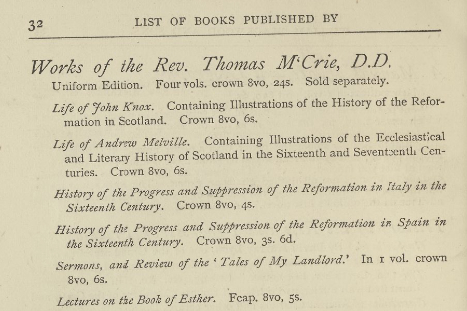
Advertisements for McCrie’s works extend the whole discussion beyond parliamentary reform toward a broader history of moral and religious struggle. His biographies on reformers like John Knox, Andrew Melville—as well as books on the Reformations in Scotland, Italy, and Spain—make reform appear as a historical tradition of conflict over truth, authority, conscience, and corruption. This matters because Eliot’s “Prelude” frames Middlemarch in terms of frustrated vocation and unrealised moral grandeur. The “later-born Theresas” of modern life, for example, live amid “dim lights and tangled circumstance” (Eliot 1). Advertisements for McCrie place those modern tangles against the backdrop of earlier, more heroic narratives of reform. But Eliot’s realism refuses to grant her characters the clarity available to Protestant martyrs or ecclesiastic struggle. Eliot’s Dorothea does not enter history as McCrie’s Knox does. Instead Dorothea enters a dense provincial web where significance disperses rather than concentrates. The McCrie advertisements therefore sharpen, by contrast, what is modern in Eliot’s realism: reform survives as a concept but is diffusion not revelation.
Class Tension and Lived Reality
Freedgood’s work is especially valuable because it helps explain why these advertisements matter at all. In Chapter 4 of The Ideas in Things: Fugitive Meaning in the Victorian Novel, she argues that Victorian texts are saturated with fugitive meanings that lodge in objects and details, often beyond what plot requires or criticism has traditionally acknowledged (112-113). Freedgood is interested in underdetermination, in how things open outward into histories and structures larger than their immediate narrative role. That is exactly the right vocabulary for thinking about advertisements. They are “things” in the publication: printed objects with obvious commercial functions (112). But they are also overfull with social meaning. In chapter four of her book, Middlemarch in the Twenty-First Century, Kate Flint agrees, showing, alongside Freedgood, that “things” carry political theory, imperial history, constitutional discourse, theology, class aspiration, and reading practices into the same physical space as the novel (Flint 74). The point, however, is not that every advertisement secretly contains a thesis statement for Middlemarch. It is that realism in the original publication is underdetermined by plot alone. Objects, advertisements, the text itself, each distribute significance that literary criticism might strips away in the name of purity. Freedgood and Flint let us restore those elements without reducing them to mere context.
Gallagher helps in a different but complementary way. Her formulation of realism as a tension between type and instance is crucial because the advertisements themselves operate in that same tension. Each ad stands for a general discourse—democracy, constitutionalism, reform, Reformation history, cheap print—but does so through a specific object: this title, this edition, this purchasable book. They are abstract and concrete at once. So too with Eliot’s characters. Mr. Brooke is both a recognisable social type and a singularly ridiculous person; Dorothea is at once a modern Saint Theresa and an irreducible young woman making disastrous errors; Casaubon is both the type of dry scholar and this particular man with these particular failures. Thus Gallagher helps explain why the advertisements feel so apt to the novel’s world: they are formally analogous to Eliot’s characterisation. They transform broad discursive categories into particular printed instances, just as the novel transforms social and historical forces into individual lives.
This analogy becomes stronger once Woloch and Brilmyer are brought in. Woloch’s argument about minor characters is, at base, an argument about the unequal distribution of narrative space. Major characters never wholly monopolise the social world of the novel; minor characters register pressures, relations, and unrealised possibilities that exceed the protagonist’s arc. Dagley matters immensely for this reason. He condenses into a brief scene a whole social field that the novel cannot fully unfold elsewhere. Eliot first frames him through the material poverty of Freeman’s End and “the depression of the agricultural interest,” before adding that drink and “muddy political talk” had made “poor Dagley seem merry: they only made his discontent less tongue-tied than usual” (268-269). When he finally speaks—“there’s to be a Rinform, and them landlords as never done the right thing by their tenants ’ull be treated i’ that way as they’ll hev to scuttle off… it were to send you an’ your likes a-scuttlin’”—agrarian grievance, class antagonism, and reform politics erupt all at once (270). Dagley is not developed with the psychological fullness Eliot gives Dorothea or Lydgate, but he is socially dense in another way: through him, the resistant realities of rural life break directly into Brooke’s paternal self-image and into the novel’s broader discourse of reform. Dorothea’s own reformist imagination reaches toward such realities when she declares that “we deserve to be beaten out of our beautiful houses” for allowing people to live in degraded cottages (Eliot 27). Dagley makes that statement harder, less abstract, less philanthropic. He is one of the places where the novel’s reform discourse touches resistant matter.
Brilmyer sharpens this by arguing that Eliot’s characters are not just minds but forms of material character. Her reading of “glutinously indefinite” bodies and minds in Middlemarch resists the habit of treating Eliot as merely a novelist of psychological interiority. Character in Eliot is soft, plastic, responsive, relational. That helps me make a further claim: the advertisements behave like minor characters. They occupy small textual space, but they carry a social density disproportionate to their formal scale. Like Dagley, they are easy to overlook if one reads only for plot. Like Dagley, they register systems larger than themselves. Like Brilmyer’s materially constituted characters, they are not inert symbols but active sites where meaning takes shape.
Print Culture and the Circulation of Knowledge

The Tinsley Brothers “cheap editions” advertisement may be the clearest example of the whole argument because it forces the question of readership and circulation into the open. The earlier advertisements place Middlemarch beside political and theological discourse; this one places it inside a market. Cheap editions do not simply indicate that books are sold. They indicate stratified access, aspiring readers, the expansion of print culture, and the reorganisation of literature as commodity. That matters because Middlemarch is itself full of documents, pamphlets, notebooks, and paper systems that are both enabling and disordering. Mr. Brooke says, “I have documents… I have documents at my back” (Eliot 16), only to admit that “everything gets mixed in pigeon-holes” (16). Print in Eliot is never merely enlightenment. It is accumulation, misreading, dispersal, aspiration, and failed organisation. The cheap-editions advertisement makes that condition external and visible. It tells us that the novel reaches readers through a social machinery of circulation that belongs to its realism rather than lying outside it.
Caroline Levine’s account of realism as a convergence of overlapping forms helps bring these threads together. Realism is not one thing in Middlemarch. It is historical reference, moral commentary, social network, material objecthood, and publication form. The advertisements matter because they do not interrupt realism; they reveal that realism was never singular to begin with. If twentieth-century criticism often purified the Victorian novel into coherent world, omniscient narration, and unitary ideology, the original publication of Middlemarch resists that purification. It is ragged by design. It is mixed. It makes readers move between fiction and nonfiction, between narrative and marketplace, between local provincial lives and much larger political and historical discourses. In that sense, the original Middlemarch is more realist than the stripped modern paperback, because it makes visible the layered mediations through which any social world is apprehended.
Seen in this light, the advertisements are not mere supplements to Eliot’s realism but part of its method. Beaty shows that Eliot hides history in plain sight by scattering it across the novel; Freedgood shows that meaning in Victorian culture adheres to material objects and details beyond their obvious function; Gallagher shows that realism continually moves between abstraction and singularity; Woloch and Brilmyer show that apparently minor forms can hold disproportionate social and material force. My intervention has been to bring these conversations together around the original advertisements. They form a paratextual analogue to indirect history and minor character: compressed, overlooked, yet densely charged. They do not summarise the novel, but they help constitute the field in which its meanings become legible.
The strongest conclusion is therefore also the simplest. Middlemarch does not stop where its plot stops. It distributes itself. Its realism is not confined to what happens to Dorothea, Lydgate, Rosamond, or Casaubon. It extends into the forms through which readers encounter those lives: political names, documentary fragments, minor characters, material descriptions, and, crucially, the advertisements printed beside the text. Eliot’s famous realism has so often been praised for its total picture of provincial society. What the advertisements show, however, is that the picture is never total in the sense of self-enclosed. It is total only by being distributed—across objects, across discourses, across people, across printed matter. The original publication of Middlemarch therefore asks to be read not as a sealed novel with some irrelevant commercial noise attached to it, but as a composite artefact whose margins are already part of its world.
Works Cited
Beaty, Jerome. “History by Indirection: The Era of Reform in Middlemarch.” Victorian Studies, vol. 1, no. 2, 1957, pp. 173–79.
Brilmyer, S. Pearl. “Plasticity, Form, and the Matter of Character in Middlemarch.” Representations, vol. 130, no. 1, 2015, pp. 60–83.
Eliot, George. Middlemarch. Edited by Ronjaunee Chatterjee, W.W. Norton & Company, 2024.
Eliot, George. Middlemarch: a Study of Provincial Life. William Blackwood and Sons, 1871–72. The New York Public Library Digital Collections,
digitalcollections.nypl.org/collections/8e3dbf60-087a-0133-a43e-58d385a7bbd0.
Freedgood, Elaine. The Ideas in Things: Fugitive Meaning in the Victorian Novel. U of Chicago Press, 2006.
Gallagher, Catherine. “George Eliot: Immanent Victorian.” Representations, no. 90, 2005, pp. 61–74.
Levine, Caroline. “Surprising Realism.” A Companion to George Eliot, edited by Amanda Anderson and Harry E. Shaw, Wiley-Blackwell, 2013, pp. 62–
75.
Woloch, Alex. The One vs. the Many: Minor Characters and the Space of the Protagonist in the Novel. Princeton UP, 2003.