When in Rome: Travel, Foreignness, and the Position of the Outsider in Middlemarch
The original publication of George Eliot’s 1871-2 Middlemarch was produced during a period that invoked movement more than ever, the growing railway system bringing people together and the Reform Act of 1867 destabilizing the rigidity of class hierarchies. Elaine Freedgood puts it well to say that despite being concerned with a time forty years prior, Eliot’s writing depended on the knowledge of readers from her time: “social mobility and the acquisition of substantial cultural capital is a prerequisite for rather than an effect of reading” (114). As other explorations such as those by Gillian Beer have analyzed, the paratextual materials that exist alongside the serialized form Middlemarch draws the reader's attention and impacts interpretations of Eliot’s writing, tied to the historical context of England in the 1870s. Johanna Drucker’s work on performative materiality is a useful guiding framework to consider for this form of hybrid literary source, where each reader becomes “a performer, whose performance changes the game” (par. 36). Beer notes that the time between 1832 and 1871 is the “invisible structuring arc of the book and the source of many of its most telling ironies,” the advertisements often implicated in the same social conditions, values, and viewpoints that Eliot explores (Beer 18).
Despite being a fictional place, Middlemarch becomes strangely familiar through Eliot’s realism and vivid characters; in response, the readers themselves begin to feel like outsiders, reading from a different time and influenced by a “common expectation and need” in the face of Middlemarch’s insular elite society (Beer 24). The narrator’s mention of “the growing good of the world” in the final sentence is telling; despite what characters may say or do, Middlemarch and its fictional locale cannot be read as isolated from the rest of the non-fictional world (Eliot 563). Eliot writes her story from a time of increased social and physical mobility, utilizing a microcosm of provincial England to look back at the technophobia, xenophobia, and exclusivism that thrived amidst the insularity of the past. The paratexts that exist alongside Middlemarch invite the reader’s individual performance and relate to the novel’s underlying themes of unseen interconnectedness that exists near and far—then and now—making it clear that such a place as Middlemarch and its society is neither as spatially nor temporally isolated as it may seem.

With the initial appearance and rise of W.H. Smith & Son bookstalls in railway stations from the 1850s onwards, reading became a staple form of entertainment on trains and for the thousands of people passing through stations each day (Rooney 44, 47). Since this was a noteworthy part of the readership, many advertisements in serial publications like Middlemarch were created with this audience in mind, appealing to a common subject: travel. The above advertisement from Book Two of Middlemarch for the “Granville Hotel” is evidence of this awareness, not only encouraging travel but specifically noting that “Ramsgate is the Station on both lines” as a guide for rail passengers (The Granville Hotel). Though the story of Middlemarch mostly focuses on life in a secluded locale, travel is a relevant subject throughout, shaping characters and their interactions with rural England: by book two, already Mr. Brooke has been characterized by his “youthful Continental travels,” Dorothea and Casaubon go to Rome, Lydgate appears from another part of the country, and Will Ladislaw is known to be a wanderer (18). Despite being “A Study of Provincial Life,” Eliot builds the insular nature of Middlemarch through the incorporation of mobility and by invoking knowledge of readers from her time to make comparisons and contrasts, drawing on a “common material world” (Beer 20).
Johanna Drucker explores this dynamic via her discussion of performative materiality as "probabilistic" in that it opens up a “site of potential for meaning production,” relying on the performer—the reader—to extract meaning from the novel’s materials (par. 24). Through this lens, the paratexts adjacent to Middlemarch’s story are themselves fluid and in motion. First readers were forced to wait between parts of the book, but modern audiences are able to read all eight books at once and draw broader connections, for instance between reliance on train travel by “The Granville Hotel” and arrival of the railway in Middlemarch during Book Six: “women both old and young regarded travelling by steam as presumptuous and dangerous” (Eliot 374). What initially appears as a mundane observation by the narrator changes with the context of Eliot’s time, this line becoming an indirect address to her audience that draws attention to those who now may be reading her book on the train themselves. The mutability of the book’s meaning based on the “contingent reader” utilizes their unique knowledge to “shape it differently then, and now” (Beer 15-6).
Another approach to performativity for the above advertisement can be seen with consideration of Lydgate. He is well-traveled, having studied in “London, Edinburgh, and Paris,” and Eliot contrasts him with his former Paris roommate Trawley, who Mr. Farebrother reveals to be “practising at a German bath, and has married a rich patient” (Eliot 120). In response, Lydgate makes a “scornful” comment about “men who truckle to lies and folly,” prompting readers to reflect on the medical practices of their own time (120). For those in 1872, encountering the paratext of the “The Granville Hotel” advertisement—promoting baths as a “restorer of hair” and having the ability to make one miraculously regain use of their limbs—would assist Eliot in calling upon a “stock of common knowledge” to draw comparisons to a time being explored forty years prior (The Granville Hotel, Beer 15). As a travel destination, “The Granville Hotel” then stands in contrast to Eliot’s themes: progress in Middlemarch does not come automatically with foreign influence—it must be attended to locally through work and struggle against a rigid status quo. The narrator’s comments on Lydgate’s studies abroad highlight that Middlemarch’s rurality is not the cause of its resistance to the ideas and aspirations he brings: “Edinburgh and Paris, where observation might be abundant indeed, but hardly sound” (Eliot 126). It is the practices and actions of people rather than places themselves that are the catalysts of change.
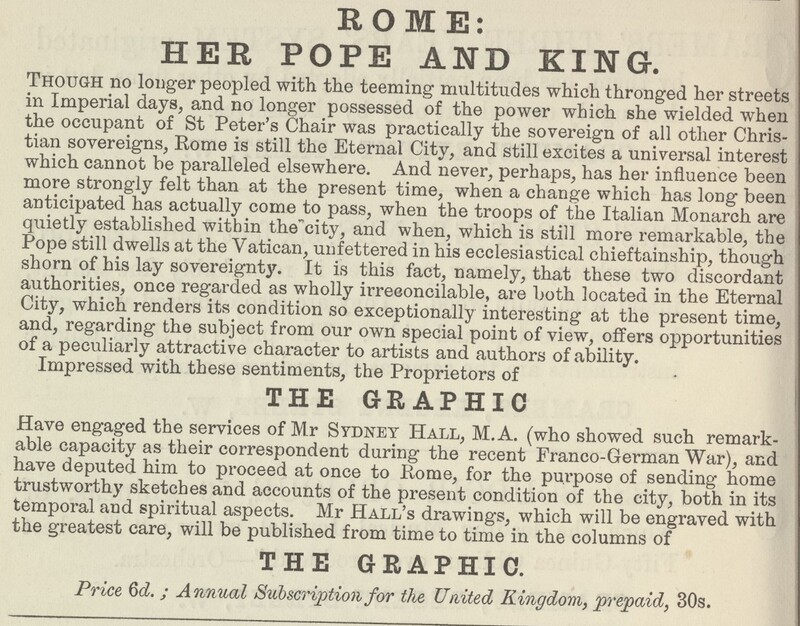
An advertisement in the second book offers engravings of drawings by Mr. Hall from Rome, lauding it as the “Eternal City” (The Graphic). Quite fittingly, this part of the novel also contains a change in narration to focus on Dorothea and Casaubon in Rome, the preceding advertisement providing a paratext that portrays the city as a destination ripe for studying. The emphasis of its “Eternal” nature and its proclaimed “universal interest” is echoed in the novel by the narrator, stating that for some, “Rome may still be the spiritual centre and interpreter of the world”—a perfect site for Casaubon’s equally ambitious “Key to all Mythologies” (Eliot 134, 44). However, Eliot’s depiction of tourism for the newlyweds is anything but romantic, grand, or universal, Dorothea instead experiencing “the weight of unintelligible Rome,” overwhelmed by its unfamiliarity, and as Barbara Hardy discusses, disillusioned by what it holds for her as a new bride on a sexual and romantic level (Eliot 134, Hardy 10). Elaine Freedgood further makes the argument that Eliot writes realism in a way where “readers are put in their social and cultural places” via specific possible meanings of the text, complementing Drucker’s notion of performativity where the unique reader is what produces meaning (114). Educated or upper-class audience members may be swayed to see Rome in a similar light of universality as Casaubon, fostering sympathy for him as he also becomes “lost among small closets and winding stairs” (Eliot 137). Those who see past Rome’s historical or scholarly value, though, would likely feel greater sympathy for Dorothea, similarly viewing the place as a “vast wreck of ambitious ideals” (134). Meanings are established for a vast “hierarchy of readers” outside of this dichotomy, even interrogating us in the modern day about how justified Casaubon is in his pursuits (Freedgood 121).
Hardy also suggests Rome acts as an “opening for foreignness” in Middlemarch, reflecting back on conceptions of rural England: “Rome displaces Middlemarch, but offers ruins, confusion, deconstruction” (1, 13). Its foreign appearance shatters the illusion that other places hold answers that Middlemarch inherently lacks. Rather than acting as “a background for the brilliant picnic of Anglo-foreign society,” Rome instead introduces and foregrounds a number of disturbances: disagreement and disenchantment for the newlyweds, the apparent temporal and spatial seclusion of Middlemarch, and most importantly, the proper entrance of Ladislaw into the story (Eliot 134). It is no mistake that he enters the narrative scope in this place, perhaps feeling the most real of all the main cast as a result of his integration with the outside, real world. From his first appearance, Ladislaw appears foreign and is othered by his refusal to fit the expectations of his class: “he declines to choose a profession” (56). The only character besides Dorothea who is initially sympathetic to Ladislaw is Mr. Brooke, who suggests that he “may turn out a Bruce or a Mungo Park”—famous explorers of the 18th century. However, Casaubon says that Ladislaw has “no bent towards exploration” and “should prefer not to know the sources of the Nile,” a clever way that Eliot hints at norms of her time and positions Ladislaw as existing in opposition (57).

The great number of advertisements for other publications about exploration throughout Middlemarch provide a fascinating contrast to Eliot's characterization of Ladislaw, who refuses such a colonial interest. Though such advertisements appear in all eight books, the ones above from Macmillan & Co. stands out particularly in Books Four, where Ladislaw is also critiqued for his foreignness, Mrs. Cadwallader suggesting he would be best “sent to India” and James Chettam pointing out his “foreign blood” (259, 258). These derogatory observations are not only used to reduce his character but also become a source of entertainment, his genealogy and race fuelling the rumour mill. Where Eliot attempts to foreground Ladislaw’s character above the intrigue of his foreignness, fostering sympathy for discrimination he faces, other advertised stories of her time were capitalizing on the sensational “sword-hunters” of the Middle East or other alluring narratives of exploration (Macmillan & Co.). This juxtaposition is also striking in Book Five when both the narrator and Lydgate call Ladislaw a “gypsy,” gesturing towards his Eastern descent, and a front advertisement promotes “Hermann Agha: An Eastern Narrative” (Eliot 314, Henry S. King & Co.). A large portion of readers were evidently interested in such narratives during Eliot’s time, and those people may have been more inclined to perform reading Ladislaw in a more stereotypical way. In this regard, Eliot was pushing back against her contemporaries, prompting readers then and now to consider how foreignness is portrayed and consumed. In fact, the advertisements' sensationalism may have inadvertently contributed to the knowledge and sympathy that Eliot was concerned with fostering for her characters (Levine 63).
The subject of xenophobia and the othering of foreign bodies does not end with Ladislaw; Bulstrode is perhaps the most extreme example in the novel, slandered as a “Jew pawnbroker” and exiled from Middlemarch society in Book Eight (Eliot 486). Though he is ethically dubious, Middlemarchers judge him based on what Catherine Gallagher refers to as “species” or “type,” mixing racial prejudice with his social standing as one who “won his fortune by dishonest procedures” to solidify his position as an outsider (Gallagher 61, Eliot 492). However, as Gallagher argues, Eliot “no sooner invokes a ‘species’ than she proceeds to dissolve it in qualifying subdivisions,” forming “triptychs” that are multidimensional (63-4). By the end of Book Eight, Bulstrode’s religious zeal and the tenderness he shows towards Lydgate and his family makes him “resemble people in their nonconformity”—not an antagonist but an outsider who struggles against the social demands of Middlemarch society (66). Not entirely sympathetic or unsympathetic, he becomes uncomfortably real to readers who then must confront the xenophobia that underlies his arc, seen most evidently from Mr. Hawley: “cursed alien blood, Jew, Corsican, or Gypsy” (Eliot 486). Gallagher writes how characters like Bulstrode are located on the “threshold of typicality between fictional illustration and persons in the world,” relevant to the advertisements that inherently are embedded with alienation and fetishization of foreign places (65). Readers have to make a decision regarding how they view these matters and it certainly affects their unique performances of Bulstrode, Ladislaw, and other marginalized outsiders in Middlemarch.

Being an outsider is a complex and multifaceted position in Middlemarch, the need to conform being a strong force that acts upon characters in different ways: Lydgate relies on alliances for financial and moral support, Joshua Rigg makes no effort to pretend, and Bulstrode puts up a false facade until he is exposed and exiled. To read further into this outsider dynamic and one way individuals become socially distanced from Middlemarch society, the product Rowlands’ Kalydor for “tourists and travelers” is useful as skin becomes an important marker of identity (Rowlands). Established by Book Five already, Casaubon’s “pale complexion which became a student,” Fred Vincy’s “white complexion,” and Ladislaw’s “transparent skin” are all positioned as being physically appealing or desirable (Eliot 12, 208, 142). While Casaubon is critiqued by Celia for being “sallow,” his whiteness is still indicative of status and intelligence in contrast to tanned skin that would be associated with those of lower class or racialized minorities (Eliot 14, de Waal 110). Dorothea’s earlier retort to Celia confirms this concern of avoiding undesirability, mocking men with a complexion of a “cochon de lait,” or suckling pig, characterized by browned, dark skin from exposure to heat (Eliot 14). The prospect of maintaining fair skin would have been an appeal to the readers of Middlemarch—especially those who also cared about fair skin also generally had the means for tourism “to the seaside” as vacation—making Rowlands’ Kalydor’s product advertisement for preventing “tan” all the more specific (Rowlands). As Beer points out, such an advertisement would “highlight lack and yearning as much as satisfaction,” the issue of skin colour performed differently for each unique reader (Beer 24). Through such a paratext, audience members begin to share what it feels like to be an outsider and desire conformity like Middlemarch’s characters, the novel’s fictional outsiders are perhaps not so remote after all.
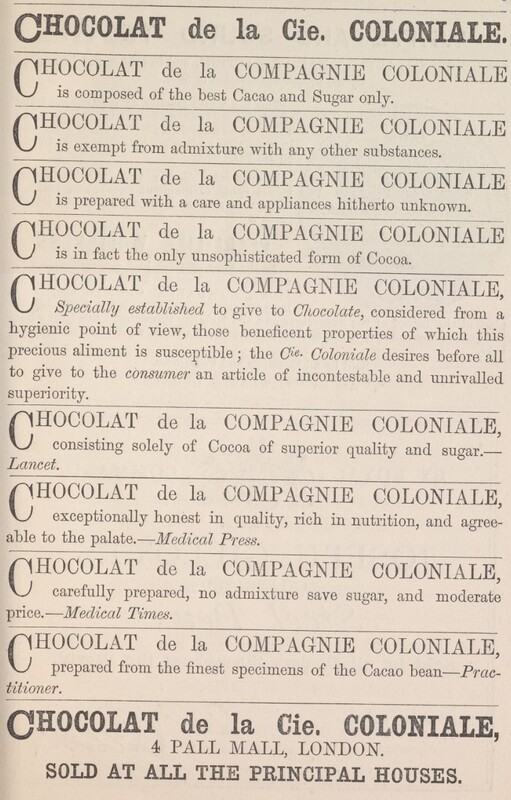
The reading of outsiders and foreignness in Middlemarch is inevitably influenced by colonial advertisements and goods promoted on the basis of their exotic value, a constant example being the “Chocolate de la Compagnie Coloniale” present at the end of every book. After Ladislaw leaves on the final page of Book Six, the reader imagining how his carriage “grew smaller in the distance,” the following page for the colonial chocolate company acts as a sort of colonial background that echoes his uncertain fate (Eliot 431). As Nancy Henry writes in “George Eliot and the Colonies,” Eliot’s own step-children both ended up in colonial positions in South Africa, the death of Thornie even interrupting Eliot’s writing of Middlemarch (418, 423). Knowing this, James Chettam’s proposition that Ladislaw should “go in the suite of some Colonial Governor” has starkly negative implications—using travel to the colonies as a sort of imprisonment by distance (Eliot 330). Oliver Lovesey similarly writes how the colonies were often used as “places of banishment, disgrace, and social excommunication, particularly for … those of mixed racial heritage” (183). Raffles, despite coming from America, returns as if from banishment after ten years; Eliot’s depiction of his destitution and want for blackmail serves well as an exemplar for what Ladislaw’s fate abroad could entail. This tone in representing colonialism stands in distinct contrast to the appeal that the advertisements were trying to produce, offering the “finest specimens of the Cacao bean” (Chocolat de la Compagnie Coloniale). While Middlemarch contains few mentions of overseas trade or direct reliance on the colonies, Lovesey notes that narratives in Eliot’s period “took for granted the imperial reality” (Lovesey 162). Tea is consumed on numerous occasions throughout the novel by many different characters, demonstrating a reliance on colonialism. And despite the exclusivity of Middlemarch’s upper-class society rooted in xenophobia, places abroad “generally viewed by most of Middlemarch’s characters with a pointed suspicion,” foreign goods are still coveted, forming a paradoxical double-standard (182). It is near-impossible to read Middlemarch in its original form and avoid noticing the advertisements for imported items such as textiles or cacao and the countless narratives centered on other parts of the world; audience members are encouraged to notice the profound effect that distant places and people have on the little rural core that Eliot develops her story around.
Despite being a study of provincial life, Middlemarch is a mobile text in both materiality and content. The serialized book was inherently tied to travel through its mass-distributed, portable nature and its story was influenced by the flexible meaning of paratextual materials that had a travelling readership in mind. The novel’s characters engage with travel in a multitude of ways, from encountering Rome, to confronting foreignness, and being subject to the label of an outsider—a product of exclusivity and xenophobia. Writing from four decades after the novel’s set period, Eliot is able to critique the insular and archaic mindset of Middlemarchers through characters like Rosamond or even Dorothea who only find satisfaction in departure, while also presenting uncomfortably real studies of foreignness that speak to her own times and those of future readers. The advertisements that litter the serial pages give the audience the power to move towards the meanings that reflect their unique identity and knowledge, performing the text alongside Eliot's historical context. Though it departs from a central, provincial core, Middlemarch happens on a global scale. It is a novel that marries places near and far to highlight movement and what it entails—to progress amidst conservatism, to move through the strata of society, and to navigate a world that is ultimately interconnected.
Works Cited
Beer, Gillian. “What’s Not in Middlemarch.” Middlemarch in the Twenty-First Century, edited by Karen Chase, Oxford, 2006, pp. 15-35.
De Waal, Ariane. “Looking Both Ways: Middlemarch, True Skin, and the Dermatological Gaze.” Victorian Network, vol. 9, 2020, pp. 101-22.
Drucker, Johanna. “Performative Materiality and Theoretical Approaches to Interface.” Digital Humanities Quarterly, vol. 7, no .1, 2013, https://dhq.digitalhumanities.org/vol/7/1/000143/000143.html#p4.
Eliot, George. Middlemarch. Edited by Ronjaunee Chatterjee, W. W. Norton & Company, 2024.
Freedgood, Elaine. “Toward a History of Literary Underdetermination: Standardizing Meaning in Middlemarch.” The Ideas in Things: Fugitive Meaning in the Victorian Novel. University of Chicago Press, 2006, pp. 111-138.
Gallagher, Catherine. “George Eliot: Immanent Victorian.” Representations, vol. 90, no. 1, 2005, pp. 61–74.
Hardy, Barbara. “Rome in ‘Middlemarch’ a Need For Foreignness.” George Henry Lewes Studies, no. 24/25, 1993, pp. 1–16. JSTOR, http://www.jstor.org.ezproxy.lib.ucalgary.ca/stable/42827623. Accessed 13 Apr. 2026.
Henry, Nancy. "George Eliot and the Colonies." Victorian Literature and Culture, vol. 29, no. 2, 2001, pp. 413-33.
Henry S. King & Co.. "Henry S. King & Co.’s New Books." The Dead Hand. Edinburgh and London: William Blackwood & Sons, 1872, front matter p. 1. Web. Vol. 5 of Middlemarch: A Study of Provincial Life. 8 vols. 1871-2.
Lovesey, Oliver. “Middlemarch’s Colonial Imaginary.” Postcolonial George Eliot. 1st ed., Palgrave Macmillan UK, 2017, pp. 159-216.
Rooney, Paul Raphael. Railway Reading and Late-Victorian Literary Series. Routledge, 2018, https://doi.org/10.4324/9781315265032.