To Have and to Hold, To Hold and to Haunt: George Eliot’s Intertextuality in the Victorian Print Market
Middlemarch, given its sprawling nature, is functionally a text that seeks to reconcile the intersecting nature of competing histories into a singular narrative structure. In this way, Eliot anthologizes a tapestry of narratives, revealing that these interconnected stories palimpsestuously inscribe themselves on one another. There is no singular narrative to be traced necessarily in Middlemarch, though Dorothea emerges as the closest as the narrative opens and closes on her life. Yet for as much as the events of Middlemarch are formed through tremendous intersection, it is the narratological that intersects the most cogently. Each chapter of Middlemarch opens intertextually, beginning with an excerpt from a classical work of literature to ground the forthcoming events. Middlemarch is, in this way, a novel about storytelling – be it through the gossip at the Green Dragon, or the books that Casaubon, Lydgate, Mary, or Fred work on throughout the novel, or through the intertextual interstitials that are ubiquitous throughout the novel. From this vantage, Eliot positions the events of the novel as iterative processes that seek to reprise literary moments alongside the process of remembering. These processes function both as narratological fixtures, whereby the epigraph itself is used to guide the reader in and out of the events of the novel, but also metatextually as invocations of classical works that were becoming commonly available due to the emergence of mass print market in Victorian England. In Middlemarch, George Eliot foregrounds memory and history as concepts that are both pluralistic and iterative, revealing storytelling to be a heterogeneous process haunted by aesthetic and narrative echoes through intertextual epigraphs, metatextual commentary, and the intersecting narrative structure.
The parameters necessary to posit intertextuality as a distinctly haunted practice can be traced through Linda Hutcheon’s work on adaptation. Indeed, Eliot’s novel is not an adaptation by any traditional sense of the definition, but is far more akin to a novel that is made up of “allusions to and brief echoes of other works” which Hutcheon suggests “would not qualify as extended engagements” and thus not an adaptation at all (9). The continued framing of Eliot’s own text by way of the continued reprisal of extant literary references is an iterative process, perhaps not any singular “extended engagement” but a series of many engagements, extended over the eight volumes of Middlemarch. Throughout the novel, Eliot foregrounds and draws from Spenserian sonnets, Shakespearean comedy, biblical apocrypha, chivalric romance, ad infinitum, and yet none of which are being adapted per se. So, if Middlemarch is not itself an adaptation, then what is it? Eliot’s repeated process of allowing other extant literary works to enter and exit the structure of her novel is a process of haunting, by which fragments, or “echoes” (Hutcheon 9) flow ostinatically through the novel’s procession, constantly enclosing the text within the broader literary canon by which it itself has since entered. From this vantage,Middlemarch isn’t an adaptation, but a novel that is enraptured, meta and intertextually, by the process of writing, by the function of the writer, and by the very nature of storytelling writ large. Middlemarch isn’t haunted in the singular, but instead it is haunted by plurality, haunted by the overlapping of discourses within the novel and beyond it, organizing itself as a structure that is fervently in the process of iterating and being reiterated upon.
Hutcheon’s article is not just useful from a negative reasoning perspective – used merely to determine what Middlemarch is not. But instead, it is the “palimpsestuousness” of adaptation (Hutcheon 6) that emerges as a lens that allows for a greater focus to be placed on the rhetorical structure of Eliot’s novel, thereby understanding not only what Middlemarch is, but also what it is doing so effectively. The epigraphic structuring of Eliot’s chapter introductions work as constant evocations of pre-existing textual material. These reprisals of classic material are palimpsestuous in their appearances, at once constantly pulling the reader into the literary sphere not by sheer aesthetic presentation of Eliot’s own work, but by pitting the novel against echoes of literary grandeur. At once, Middlemarch is both operating as a palimpsest – couching the narrative within snippets of extant literary work – and also something else entirely. Rhetorically it may appear most evidently as a palimpsest of literary mastery, but Eliot is tearing these words from their original pages and affixing them onto the pages of her own work. No, perhaps not a palimpsest, at least not entirely. Middlemarch is a palimpsest narratively, but formally it is better located as a literary collage, by which the words that Eliot is borrowing are stripped from their context and afforded new life on the pages of her novel, no longer bound to their original authorial voice, but now haunting the page of the Victorian novel, iterating as familiar, albeit disembodied, echoes.
MacMillan's Globe Library Advertisement
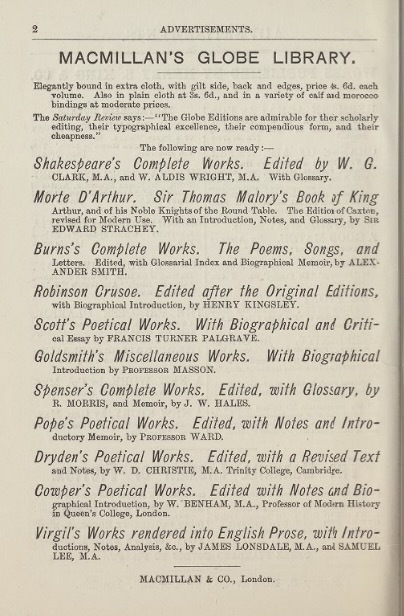
[Figure 1] Eliot is not inventing intertextuality in Middlemarch, but instead she is trading in what is emerging as a necessary grounding of literary work as both aesthetically useful, but now commercially viable. By the Victorian period, print media had become accessible on a far broader scale than ever before, and with it came a burgeoning market for print materials that was rapidly creating a new class of literary audience (Freedgood 113). Not only were new works now finding their way into mass print market, but the literary canon at large was now in the constant state of being printed and reprinted, itself a sort of Victorian capitalist form of iteration that forms the basis for which Middlemarch as haunted novel becomes aesthetically and politically viable. In the original eight-volume publication of Middlemarch advertisements can be found in the front and back matter seeking to find audiences for the works of Thomas Malory, William Shakespeare, Edmund Spenser, et al (Fig. 1). The apt nature that these advertisements would appear in Eliot’s novel is fortuitous (Beer 18), but not incidental. The advertisements themselves are keenly tethered to the market that Middlemarch is both reacting to rhetorically, but also being published through in a very literal sense. Shakespeare and Spenser are both advertised in the front matter of the novel’s third volume, indicative of a commercial audience overlap within the Victorian market – one that reads emerging contemporary works, á la Eliot’s novel, but also an audience that is receptive to reading the literary canon. This is, in essence, Eliot’s novel being used to sell other novels – by no means an uncommon practice to the Victorians – but moreover, the advertising of classic literary works inside a novel that is so tightly wound in referentiality is an auspicious reminder that the Victorians were not just interested in the posterity of the written word, but were commercially invested in the proliferation of nostalgia. Blackwood & Sons, Middlemarch’s original publishing house, are using new written material to sell reprisals of old material that has been lodged within the British zeitgeist as culturally significant. This foregrounds the Victorian British print market as something that is itself haunted; haunted by a conservative rhetoric that fixates on nostalgia as a cultural and political economy.
Epigraph from Spenser's Amoretti
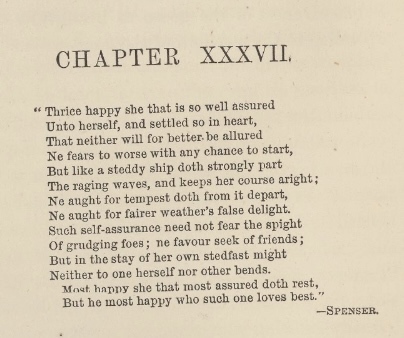
[Figure 2] Nostalgia as a political tool is an especially useful way of thinking through the Victorian print market, especially given the choices of intertextual citations that Eliot relies on throughout. But consider the presence of Edmund Spenser being epigraphed in Middlemarch (Fig. 2). Spenser, as a surrogate for British high culture, is a compelling citation to bring into this chapter, particularly as it opens a section in which political discourse is being scrutinized by Eliot’s narrator. This passage discusses “the Pioneer,” a liberal newspaper, and “the Trumpet,” a conservative paper, and the issues each were facing due to the ongoing tension and changing attitudes on both sides of the political spectrum (Eliot 242-243). This underpins the theme of political reform that ebbs throughout Middlemarch, gesturing toward the fraught nature of British political identity in the mid-19th century. Indeed the Pioneer losing readers due to its support of Peel’s pro-Catholic emancipation position is useful to frame the political theatre that Middlemarch is caught up in, but moreover the decline of both newspapers is suggestive of a broader decline in unified identity amongst the British, and inevitably one that would be tackled during the several reformations that would occur in the coming decades. Spenser slots into this equation as a relic, both literally a relic of literary greatness, but also as a haunting echo of 17th century British political identity. The work which Spenser is most famous for was, in essence, an attempt at creating the definitive British origin myth, seeking to have The Faerie Queene be to the British what The Aeneid was to the Romans. This is, on its own, a political undertaking.
The broad cultural identity of the British is being channeled into myth by way of literary formulation, and yet it is more so a potent unfurling of the cyclicality of British political theatre. Spenser’s staunchly anti-Catholic position in the centuries prior has apparently not been resolved in Eliot’s time, yet it remains a conversation that divides the British. The project of maintaining a British identity is invariably a project of maintaining certain traditional rhetorics: a literary canon that is British first, a religion that is British in nature, and a historiographical approach that is always mediated through a British lens. In essence, these concessions are rooted in nostalgia. It is nostalgia that influences the posterity of British literary works, but it is also nostalgia that allows for them to be drawn upon aesthetically and procured commercially. It was nostalgia, or the lack of something to be nostalgic for, that led to Spenser to attempt to create the uncontested British origin myth. And it is nostalgia again that led to Eliot transposing the written works of the British tradition into her own work unchanged. Unchanged, but not unaltered. They are formally altered, losing the context of their original binding, but moreover the words themselves are received differently narratologically, now seemingly referring to events they were never intended to fit, to describe characters alien to the original author.
Measure for Measure Epigraph
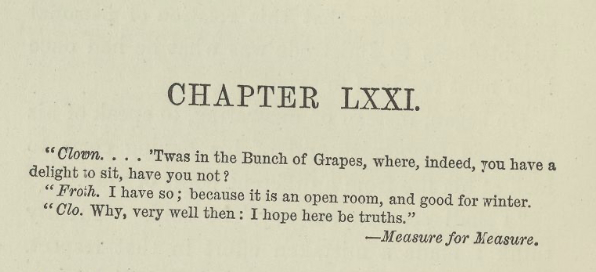
[Figure 3] As Spenser (Fig. 2) and Shakespeare (Fig. 3) are invoked intertextually, so too are they being arranged metatextually as aesthetic cultural remnants. At once, Eliot’s reiteration of classical literature draws forward an idea of shared aesthetic memory, but it undergoes a process of transliteration, not from language to language, but from an initial context of originality to a context of ebbing familiarity. In essence Eliot’s use of epigraph fixes Middlemarch as constantly pulled taut between systems of novelty and nostalgia. This tension crystalizes an iterative fascination with the structure of a formal literary canon that creates a resonant feedback loop for Eliot’s Victorian contemporary readers. As each epigraph draws citationally from British cultural milieu, the progression of Eliot’s own novel, replete with intertwining narratives built around the process of storytelling and book-writing, situates Eliot and her epigraphic citations as intrinsically a product of compounding aesthetic cultural projects across time. This plays out similarly to what Brecht de Groote refers to as “memories [of] a shared origin” (119). Here the “shared origin” that Eliot is replaying is less a singular moment to be recalled across the works of Shakespeare, Spenser, et al, but is instead a litany of cultural touchpoints that work aesthetically to form the foundations for the British literary catalogue. The specific reference being highlighted in Fig. 3 is a conversation taken from Measure for Measure between Froth, a “foolish gentlemen” and a clown (Shakespeare 2.1). The epigraphed quote that Eliot draws from is in reference to a public house, not unlike the “Green Dragon” that operates as a center for gossip throughout the novel. Middlemarch, like the scene from Measure for Measure, uses pubs as sites of storytelling, indeed iterating once more the countless iterations that a single narrative will go through, constantly being espoused and echoed by a plurality of voices. In this way the practice of implementing an epigraph is reflected narratologically by Eliot’s characters, with moments of a specific narrative being stripped of context and passed around from listener to listener. In chapter LXXI where the Measure for Measure line occurs, Eliot reflects the “foolish” Froth and his clown interlocuter in the patrons of the Green Dragon, each of which lining up to take part in the story-telling, but more accurately the verbal palimpsesting of an emerging rumour. In Eliot’s novel several characters revel in the act of storytelling, often playing and replaying the events of other inhabitants of the town to whoever should listen. In the moments following the Measure for Measure epigraph, Mr. Bambridge lights up at the chance to perform his role as vulgar rhapsode:
‘By jingo! that reminds me,’ he began, lowering his voice a little, ‘I picked up something else at Bilkley besides your gig-horse, Mr. Hawley. I picked up a fine story about Bulstrode. Do you know how he came by his fortune? Any gentleman wanting a bit of curious information, I can give it him free of expense. (Eliot 484).
This moment is reflective of Eliot’s overall interest in the act of narrative crafting and the reiteration of existing narratives. Eliot’s likening of Mr. Bambridge, Mr. Hawley, and the other patrons of the Green Dragon to foolish-Froth and the clown, Eliot reminds her readers that while storytelling remains an omnipresent fascination throughout the novel, she does not equate all forms of storytelling as artistically generative. Meanwhile, Mary’s publishing on Plutarch is itself a reiteration of sorts, as it too reprises stories that are preexisting, but rather than being foolish gossip spread between snifters of brandy, it is shared by the erudite to the literate, forming the basis for future enjoyment of literary masterworks through the process of translation, iteration, and publication.
Whereas the haunting of memory from the framework of the palimpsest is felt as a constant redoubling of the earlier narrative haunting the subsequent hypertext, the literary collage is haunted by a plurality, where Middlemarchworks as a cascading of many hypotexts into the singular Victorian hypertext. This further builds on de Groote’s notion of an “absolute origin” (118) for hypertexts and their hypotexts, but is further complicated by Eliot’s circularity of her citations. The “absolute origin” of the numerous hypotexts that Eliot replays are effective in so much as they are haunted by a common cultural memory, yet this is predicated on a degree of slippage, where the origin can only be “imposed” by the reader while paradoxically being necessitated a priori for the origin to even exist (de Groote 119). Meanwhile, for the supposed singular origin to operate as a tethering of Middlemarch as hypertext back to the numerous hypotexts, the reader must “be able to identify and recognise it beforehand, and that one structure reality to suit its image. The origin is less a thing lost and found than it is a thing created” (de Groote 119). If the hypertext is created through the process of creating and recreating aesthetic touchpoints by way of literary tradition, then the printing market works to literalize this structure by keeping the canonical texts readily available within the laissez-faire Victorian market. Moreover, the transposition of texts citationally within a larger and otherwise original literary project cannot be charged to a singular authorial voice. Eliot plays with this idea directly, suggesting in the closing moments of Middlemarch that “there was no need to praise anybody for writing a book, since it was always done by somebody else” (558). The “somebody else” of this figuration exists within the novel itself, whether it be the unsure boundaries of Dorothea’s work on Casaubon’s treatise, Mary’s book on Plutarch, or Fred’s publication on farming (Eliot 44, 558). The delineation of who is writing and what narratives are being invoked is constantly in a state of slippage, where credit will be erroneously handed out to the wrong person, withheld entirely, or otherwise forgotten about.
Print Ad for Wise, Witty, and Tender Sayings by George Eliot
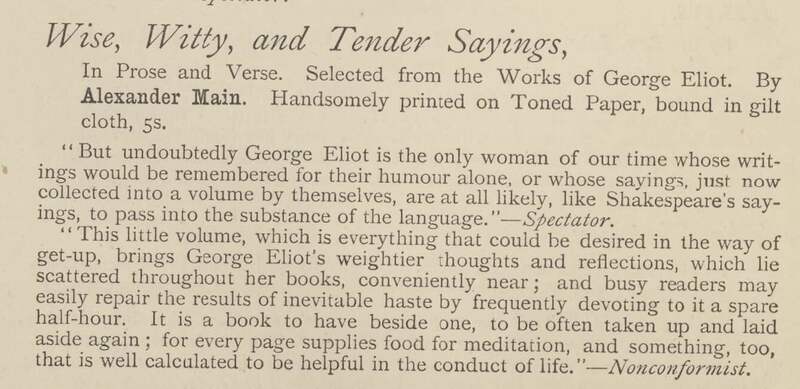
[Figure 4] By the publication of Middlemarch’s eight volume, Blackwood & Sons had begun advertisements not just for literary classics, but for Eliot’s herself. This, on its own, is hardly surprising from a marketing viewpoint; it is only natural that readers of Eliot’s work would be the most likely to purchase more of her literary material. Yet what specifically is being marketed is perhaps far more interesting than any other textual material so far referenced paratexually by the publishing house. Fig. 4 shows an advertisement for Wise, Witty, and Tender Sayings by George Eliot, a compendium of Eliot’s most famous or otherwise noteworthy quotes. In essence, this is an advertisement for a chronicle of epigraphs, circularly being advertised by a novel that is framed, almost entirely, by a series of epigraphical references to other earlier works. Although Eliot herself would have had no knowledge of these advertisements as the time of her writing Middlemarch (Beer 18), it is further evidence of the role nostalgia and iteration play in the Victorian print market. As the novel itself winds to a conclusion, readers need look no further than a future publication from the same publishing house to allow them to relive the mastery of Eliot’s prose. In some capacity, Eliot has herself become a caricature to be epigraphed, her own book being used to stir a nostalgia for her own earlier writing. Eliot went from epigraphing the British canon to having her own words torn from their context and packaged wholesale in bulk. This is perhaps the most corrosive example of how book-writing and publishing had become, and would continue to become, a viciously capitalistic pursuit. Eliot’s work is hardly being upheld in their original aesthetic or artistic constructs, and are instead being retooled and churned out for instant gratification from readers. This form of publishing is much akin to Hallmark’s endemic clip-quoting and printing of excerpts from Auden, Browning, and Hesse onto cardstock to be given haphazardly at every greeting-card-warranting occasion. Indeed, the hypertextual citations of Eliot’s novel was being executed with a sense of aesthetic purpose, well-measured and articulated moments to be carried forth out of nostalgia and brought to fresh context within an emerging narrative structure. The same cannot be said for Alexander Main and Blackwood & Sons, which are not crafting an artistic piece, but are instead creating a commercial product from the scraps of Eliot’s extant literary works.
Throughout Middlemarch, Eliot is constantly acting out the tension of creation from within the process of iteration. Whereas the epigraphs tether each chapter of Middlemarch to an earlier literary work, the paratextual advertisement for other works reframe these epigraphs as both nostalgia-bound and indicative of the broader cultural project of creating a print-ready British literary tradition. By the Victorian period, the British literary tradition had long been solidified as critically and culturally important, yet the advent of mass market printing created new avenues to convert, or exploit, this canon for commercial gain. While the emergence of new printing technologies created an entire new class of readers, so too did it create a new class of consumers, ready to part with their wages to participate in the literary field that had, for many years, been closed off to the middle classes. Yet to suggest that Eliot’s epigraphing is itself predatory or inherently capitalistic would fail to recognize the nuance in reading Middlemarch as both a novel about novels, and project seeking to construct storytelling as the overlapping of many harmonising and contrasting voices. Middlemarch draws on the idea that stories emerge from within other stories, that memory serves as a bridge to locate the temporal present within a tradition of aesthetic creations that compound and meld together, crafting a gestalt out of the echoes of earlier work. These echoes of literary tradition haunt Middlemarch just as they haunt the process of artistic generation at large, but it is the Victorian print market that sought to channel these hauntings into capital.
Works Cited
Beer, Gillian. “What’s Not in Middlemarch.” Middlemarch in the Twenty-First Century. Edited by Karen Chase, Oxford, 2006, pp. 15-35.
Eliot, George. Middlemarch. 1871. Norton, 2024.
Freedgood, Elaine. “Toward a History of Literary Underdetermination: Standardizing Meaning in Middlemarch.” The Ideas in Things: Fugitive Meaning in the Victorian Novel, University of Chicago Press, 2006. ProQuest Ebook Central, http://ebookcentral.proquest.com/lib/ucalgary-ebooks/detail.action?docID=574742.
de Groote, Brecht. “The Palimpsest as a Double Structure of Memory: The Rhetoric of Time, Memory and Origins in Thomas De Quincey and Thomas Carlyle.” Orbis Litterarum, vol. 69, no. 2, April 2014, pp. 108–33, https://doi.org/10.1111/oli.12055.
Hutcheon, Linda. A Theory of Adaptation. 2nd ed., Routledge, 2013.
Shakespeare, William. “Measure for Measure.” The Norton Shakespeare Later Plays and Poems. Vol. 2, 3rd ed., Edited by Stephen Greenblatt et al., Norton, 2016, pp. 467-536.