Transcend or Die Trying: Middlemarchers and Pulling Out of the Self
By Hansol Baek
In “What’s Not in Middlemarch,” Gillian Beer remarks on the interaction between the books and advertisements contained in the original publication of George Eliot’s Middlemarch, in that the ads— especially when read in tandem with the text— directly engage with issues in the novel. She further remarks that in particular cases, the “unironic juxtaposition of text and advertisement seems positively scandalous” (19). The advertisements, functioning as snapshots of concerns specific to the time of publication, in their promotion of health and beauty products alike, seem to offer solutions to a central issue that many of the Middlemarchers’ grapple with— ascension of social class. However, the issues that the characters must navigate are much more complex, revealing that it takes much more than just purchasing a product or service to gain social capital, complicating some of the marketing tactics used by these companies. That being said, it ultimately falls onto the reader to discern whether extra material such as advertisements perpetuate or challenge issues raised in the novel.
Although Beer only applies the idea to of ‘unironic juxtaposition’ to the interaction between the advertisements and text, this operates explicitly in the characterization and interactions between the characters in the novel as well. While the interplay between the books and advertisements reference existent issues displayed in the narrative, the juxtaposition of the novel's characters complicates the sentiments and social structures perpetuated and operating at higher levels and reflected in the products of the mid 1800s. In this essay, I will extend Beer’s concept beyond the advertisements included in the original publication of Middlemarch, and analyze how the characters themselves are nestled in this ‘unironic juxtaposition’ with each other, revealing the various failures and successes in transcendence from a lifes of plain mediocrity. I will also do this with consideration for specific methods and definitions that operate in masculine and feminine contexts in the novel.

Advertisement: Allcock's Porous Strengthening Plaster
First of all, it must be stated that similar to how the male and female characters are impacted by separate societal pressures and expectations respective to gender, methods and goals for transcendence differ between the men and women of Middlemarch. I will explore the masculine pursuit of betterment to begin, with looking at Lydgate. Both Casaubon and Lydgate are attracted to a heroic form of ascension from mediocrity, and therefore their goals aim considerably higher than many of the female characters. And though Casaubon serves as a good example for a character who ultimately fails to achieve their goal to transcend— especially in his failure to complete his “Key”— I will be focussing on Lydgate, namely in his more intentional attempts to incite change and the reaction he garners from the townspeople. Compared to Casaubon’s desires, which seem self-serving and convoluted in comparison, Lydgate’s ambitions in setting up the fever hospital are supported by more communally beneficial goals aimed at utilizing his skills to cure relevant illnesses. His new methods as a doctor are not always well received by this community, however, and to this he directly compares it to a “hampering threadlike pressure of small social conditions, and their frustrating complexity” (Eliot 125). Up until his death, Lydgate remained as a doctor whom patients still relied on, but felt like a failure nonetheless, having felt that his dreams of becoming a “model doctor” (122) and dreams for Bulstrode’s hospital were smothered. Having unable to transform Middlemarch through his practices, he was left irrevocably changed instead.
Allcock’s plaster, as promoted in the advertisement above, promises a quick and cheap cure for major ailments, supposedly allowing the “lame to walk” through a small payment of twenty-seven halfpence— a striking statement. This product advertises itself to be cost effective, simple to use, and extremely versatile in its healing properties, almost to a degree of vagueness that undermines its lofty abilities. While to a passing reader, this plaster may appear to have been helpful to someone like Casaubon, who passed quite suddenly and without prior signs, his juxtaposition with Lydgate’s character— a medical practitioner— complicates this idea. With his refusal to readily dispense drugs at a patient’s mere request, he, like Eliot, would express his distaste for ‘quacks’, or “ignorant or canting doctors” (101) who may promote a product similar to this. However, the circulation of an advertisement like this several decades after the time of the novel’s setting, only confirms that medical quackery and sensationalized products remained alive and well.
It seems as though Lydgate— with his seemingly righteous choices to defer from unnecessary prescribing of drugs, as well as investments in the fever hospital— was meant to be the catalyst for change, or the emblem for development for the town. However, with his lack of funds, unwillingness to bend to others, and he fails to transcend the common life dictated for the Middlemarch doctor. It was his egoism that partly stood in the way of his dreams. Lydgate was never shy to comment on the predispositions towards medical practices and religion “being given to prayer . . . there would have been a general presumption against his medical skill” (125) and goes as far to acknowledge his enemies. He likens himself to Vesalius, a physician who was met with hostility throughout his career, yet retaining hope in how “the facts of the human frame were on his side; and so he got the better of them,” (311). When he is accused of murdering Raffles, coupled with his accumulating debt, his hopes to reform the provincial medical practices of Middlemarch never truly come to fruition. Lydgate was ultimately blinded by idealistic image of a reformed his imbued with ego, yet promised no for reform himself to be able to integrate into the ‘complex web’ of Middlemarch, which is crucial if he were to suggest such ambitious reform.
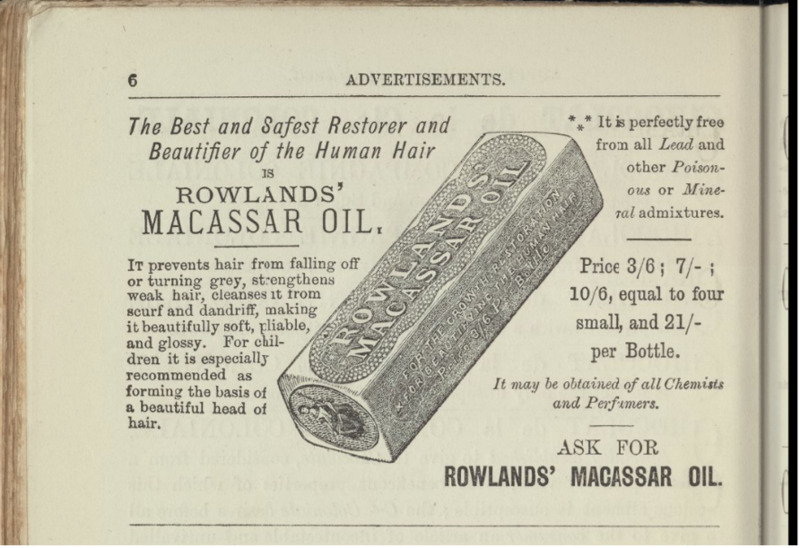
Advertisement: Rowlands' Macassar Oil
To contrast with the last advertisement, this one on “Rowlands’ Macassar Oil” promotes the restorative and aesthetic improvements of hair when used. In particular, there is specific attention paid to Rosamond and Dorothea’s hair. The promotion of various hair products in the original publications of this book instills a youthful beauty that is financially achievable by all who can purchase these items. For instance, Dorothea’s “gem-like brightness on her coiled hair” (Eliot 187) and “wondrous crown of hair-plaits” (294), correlate healthy, illuminous hair with feminine beauty. This points to the method by which Victorian women could most easily transcend— through grooming of physical appearance. By using specific language to promote the oil as a “Restorer” of hair colour— referring its form before showing signs of greying— this advertisement equates beauty with youthful qualities, as if showing signs of age is not natural by definition.
In her article “Toward a History of Literary Underdetermination,” Elaine Freedgood makes a striking connection to social hierarchy, in writing that “the rhetorical plot allegorizes a plot of class mobility: if you can access a tradition, you can, potentially, move up in the world” (124). Products like these, aimed centrally towards women, supposedly provide this ability to move up the social ladder. A reader, when offered images of the female characters’ voluminous, glowing hair, may view this product as a way to achieve these same attractive features, and marry favourably as several of the novel’s women have.
Rosamond’s beauty—while remarked to be stunning even at brief study— represents a more meticulously constructed, self-aware beauty, with her intricate hairstyles and dresses made so perfect that “no dressmaker could look at it without emotion” (Eliot 294). Earlier on, she is even described to be “industrious” (116) in her efforts to curate her appearance. Much like her performance, the promise of ascension based on appearance proves to be a façade. Her obsession with a scandalously attractive image of herself and Ladislaw results in her damaging relations with both the subject of her imagine affair and Dorothea.
In the same way, Carol-Ann Farkas’ writes Rosamund as “infantile” (339) in “Beauty is as Beauty Does,” referencing a common association between Rosamond and childish images. She claims furthermore that Rosamond “possesses a species of ignorance, complacency, and passivity that can only come from a life of too much sheltered ease” (336). I assert that it is this natural, yet painfully self-aware, youthful beauty of Rosamond’s that attracts characters such as Lydgate, who views her as a “young creature [who] depended on him for her joy” (Eliot 206). It must be noted that they are both responsible for their bankruptcy, as Lydgate has his own sense of egoism and sense of liberal consumption in the name of medical investment. Rosamond’s performativity is rooted in a childish desire to be helped and sheltered, and is largely surrounded by those, like Lydgate and Mr. Vincy, who reinforce this behaviour. Her ‘natural self’ is conflated with childish qualities, exemplified in the description that she was “as natural as she had ever been when she was five years old” (205) during an intimate moment with Lydgate. In Rosamond’s constant performance and awareness of being perceived, lies a subtle expression of a desire for deeper engagement with others in her consistent efforts to appease them. Unfortunately, she never manages to break free, or ‘grow up’ from her obsession with a curated sense of self, and reinforces this when she marries an even wealthier— albeit older— doctor after Lydgate’s death. The reader, having been met with the “Rowland’s Macassar Oil” advert multiple times over the books is also left divided on the preoccupation on the cultivation of outer appearance, and the potential outcomes of a life rooted in performance.
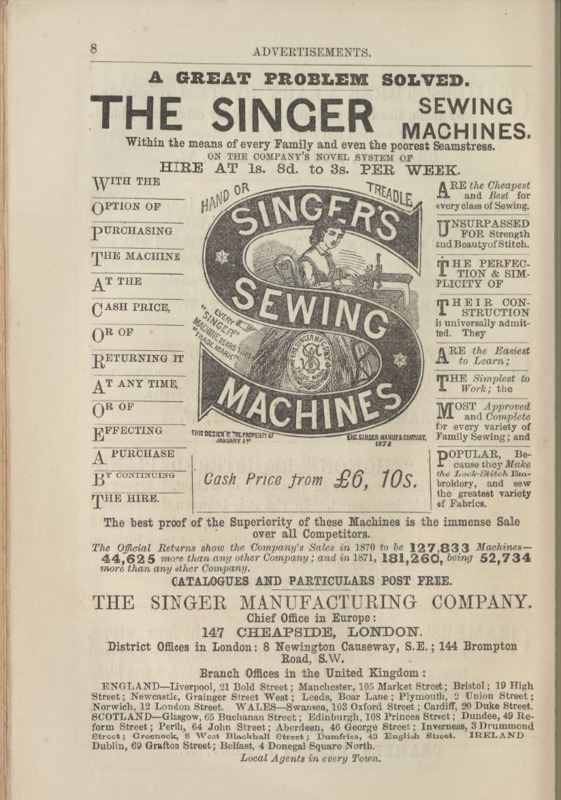
Advertisement: The Singer Sewing Machines
Although Dorothea lives a life of general financial stability as a woman belonging to the upper middle class, she does not possess the same drive towards betterment as do Lydgate and Rosamond— at least in terms of wealth. Freedgood writes that “Dorothea begins her adulthood with a highly personal and largely confused (and confusing) approach to the interpretation of objects. She is variously oblivious or indifferent to, or overwhelmed by things” (118). Immediately, she is juxtaposed with Rosamond, who acts and dresses accordingly to live up to upper-middle class standards (Farkas 336). On the other hand, Dorothea’s characteristic unease with excess falls in line with her lack of desire to invest in herself financially. In fact, where an opportunity for Dorothea to give up wealth to aid another, presented itself, she agrees. Despite the frustration that permeated Fred Vincy’s social circle due to his unfortunate turn of events with gambling, she was the one to lend him money to save him from debt. She is attracted instead to cultivating internal contentment, and perhaps even self-assured ‘goodness’. For instance, in knowing that people are well-housed in Lowick (Eliot 21) and that she will be promised satisfaction of her “love of knowledge” (33) through marriage. Her ability to resist excess in any form is striking, and can translate to an exercise of agency.
In the advertisement promoting Singer sewing machines, the phrase “A problem solved . . . Within the means of every Family and even the poorest Seamstress” is used, illustrating opportunity for those in lower classes to increase their practicality through this quick and easy method. This advertisement promises betterment for even the poorest of women through hard work alone. The reader may apply this same image of the hardworking, self-less woman to Dorothea, who is shown to be restless with lack of work, and wants to be useful to Casaubon— even claiming that his “liberal” arrangements of his property, and resultant lifestyle of leisure, make her unhappy (Eliot 254).
Returning to the idea of transcendence, Dorothea is notable in her ability to break away the ordinary life she had surrendered to in marriage with Casaubon, noting that her life is to be very simple, to which Ladislaw compares to a “dreadful imprisonment” (266). She has “no longings,” (266) indicating the near complete lack of selfish interiority. This proves to be untrue, when she is liberated from her unhappy marriage. This ascendance and transformation is marked in book 5, as the death of Casaubon sets her world into a “state if convulsive change . . . she must wait and think anew” (333). After considering the implications of her former husband’s will, she rather suddenly gives into her internal longing that she seldom expresses through the novel, through the radical act of relinquishing the inheritance and marrying Ladislaw. Her desires have never been tied to the material world, and therefore her method for transcendence must be the outright rejection of it. Casaubon’s sudden death forces Dorothea out from the already fading “pale fantasy” (188) of a life that was coming into view. Where it would be expected of her to choose a stable future with inheritance, she makes a choice that alters the course of her future entirely. In going against the conditions of his will, she also rejects the mundane life set out for her. Just as she had in the very beginning looking at jewelry with Celia, Dorothea successfully transcends an expected, quiet life in Middlemarch, by denying wealth until the very end— in true Dorothea fashion.
When considering Middlemarch in its composite form of eight separate books including various advertisements, it warns the reader of the products and services that may be presented as quick solutions to common desires of social and economic gain. At first glance, the reader may truly regard “Allcock’s Porous Strengthening Plaster” as an effective cure for most ailments— to which is suggested by the vague reference to several unrelated afflictions that the product promises to heal. But with consideration to the sudden manner of Casaubon’s death, the plaster presents itself as a flimsy band-aid for serious concerns. Middlemarch is brimming with Beer’s aforementioned intentional juxtapositions, it physicality for interacting with text, the varied fates of the Middlemarchers in search for transcendence suggest that much more than what seems crucial on the individual level. What unites both the male and female characters in this novel is, the human desire for betterment and ascension towards an ideal, however far this goal is. Rosamond and Lydgate fail to achieve true transcendence— Lydgate in his inability to engage properly with Middlemarch society and rather early death at fifty, and Rosamond in her refusal to leave behind childish fantasies. Without internalized efforts to transform both their internal and external worlds, the characters remain trapped in the comfort of their conditions. Dorothea’s rejection of a life with a promise for comfort frees her from a future of stagnancy and subordination.
Works Cited
Beer, Gillian. “What’s Not in Middlemarch.” Middlemarch in the Twenty-First Century, Oxford University Press, 2006, pp. 19.
Eliot, George. Middlemarch: A Study of Provincial Life. Edited by Ronjaunee Chatterjee, W.W. Norton & Company, 2024, pp. 21-333.
Farkas, Carol-Ann. “Beauty is as Beauty Does: Action and Appearance in Brontë and Eliot.” Dickens Studies Annual, Penn State University Press, 2000, vol. 29, pp. 336-39.
Freedgood, Elaine. “Toward a History of Literary Underdetermination: Standardizing meaning in Middlemarch.” The Ideas in Things: Fugitive Meaning in the Victorian Novel, University of Chicago Press, 2006, pp. 118-24.