Patently Obvious: Narratives of Invention and Improvement in Middlemarch
Original editions of Middlemarch and the advertisements contained within it offer a remarkable glimpse into the ways in which Victorians understood progress as the result of ongoing and relentless invention and improvement. This fascination with “newness” finds its way into the very corners of Victorian life, even into provincial Middlemarch. While there is a significant body of scholarship that connects scientific research and discovery activities to literature of the period, there is an opportunity to explore the so-called mindset of invention and innovation that is evidence in advertisements to connect them to a broader sense of “inventedness.” Within Middlemarch, we can see the imprint of invention and improvements that are the hallmarks of Victorian perspectives on their world.
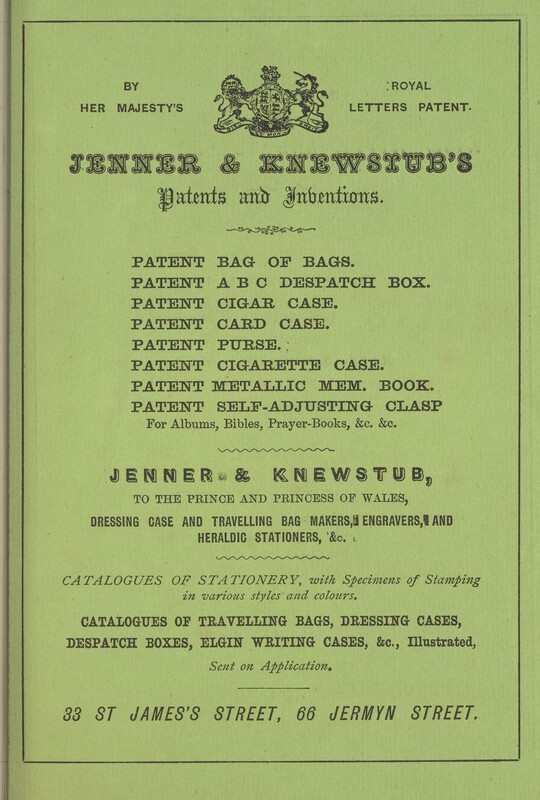
Victorian-era advertisements frequently reference patents in their copy, referring to “patented” processes and products to emphasize the use of new technologies and resulting inventions. Prior to 1852, British patents were poorly regulated, and by the Great Exhibition of 1851, which showcased the very latest and best in British ingenuity and engineering, legislators in the House of Commons and House of Lords were engaged in the reading of amendments to the patent law. By the time of Middlemarch’s printing in 1871 and 1872, the amended Patent Bill of 1852 had already passed into law, offering intellectual property protection to inventors and innovators at a lower cost. It’s striking that the language of patents is still very much in evidence in advertisements nearly twenty years after legal protections were strengthened, and offers insight into Victorian modes of thinking that conflated the patent with the larger discourse of productivity, innovation, and accomplishment across the period.
“Business breeds,” comments Caleb Garth (374). Middlemarch is not explicitly a novel about agricultural or manufacturing industries, but it does connect characters to the growing changes in these sectors. Dorothea’s drafting and planning for improvements aim to improve the living arrangements for leaseholders and tenant farmers; Mr. Vincy’s rotted silks and Bulstrode’s questionable business dealings show how commerce involves itself in the life of Middlemarchers, and even Lydgate’s medical aspirations and his plans to establish a fever hospital suggest an entrepreneurial mindset that, in Victorian times, was better understood as a kind of thinking and doing that would benefit Britain and, by extension, make life better for the population. The language of patent law, for example, endorses this way of thinking: patents are granted by Queen Victoria, herself “being willing to give Encouragement to all Arts and Inventions which may be for the Public Good” (425).
In the Victorian era–perhaps not that much different from our own–technology and science moved from the theoretical space to practical with extraordinary speed. Patents offered a way to protect intellectual property from theft or piracy–again, not so different from now–but became a method to signal that a product had undergone some innovation. Lori Ann Loeb’s study of advertisements examines the ways that even the most “mundane” projects and products were infused with an almost “magical aura” when technology and science were used to market them, commenting that advertisements “consistently present products of varying sophistication and intricacy as pinnacles of technological advancement” (53). Patents, she argues, were not solely used to protect intellectual property rights, but were increasingly used to communicate a “marketing strategy of newness” (53) that “lent the product the cachet of invention” that promised “an exciting, but undefined, potential” (54).
Compared to contemporary times, Victorians applied for fewer patents, but were more successful in gaining them. Rates of 11 patent applications per 100,000 people in 1861 and 1871 were considerably lower than those seen in the United Kingdom in 2015 (35 per 100,000 people) or 2024 (30 per 100,000), but Victorian inventors and manufacturers were significantly more successful: issuance ran at a rate of 7 patents per 100,000 people compared to just over 1 per 100,000 in 2024. Certainly the complexity and sophistication of technologies, as well as a gradual tightening of requirements (patent law being reformed periodically since 1852) intersect with these numbers, but it does provide context for the relative pace of innovation and inventiveness of the period.
This data, drawn from datasets on patents published by the Intellectual Property Office in the United Kingdom and from census data published by the British government for England–historically and more recently–suggests that while the pace of patent applications are significantly higher in contemporary times, the actual approval rate was similar to that in 2015, before the protracted impacts of the pandemic and a resulting sharp decline in grants that were reflective of a global slowdown in innovation.
I use this as an indication of the inventiveness that persisted throughout the Victorian people: to show that there was sufficient interest not only in creating new products–and advertising them for sale–but on inventing “newness,” such that the mindset of improvement persisted to the point where it was codified and worked its way into the daily language of commerce. Caleb Garth’s focus on business arising from change–the construction of railroads, for example, which are just “beginning to breed” (374), even though, as Eliot’s narrator comments, “the human mind in that grassy corner had not the proverbial tendency to admire the unknown,” (375). The railway “will be made whether you like it or not,” Garth says, pointing to the inevitability of the pace of technological change, cautioning that interfering in it will mean that “you’ll have to do with the constable and Justice Blakesley, and with the handcuffs and Middlemarch jail” (379).
Patent data reflects the “day-to-day adaptation of technology,” (Cantwell 40), and is a suitable measure for demonstrating technological progress. Cantwell’s assessment of Victorian economics acknowledges that “some innovations are never patented, and that some patents either have little qualitative impact or are never used” (42), but that the pattern of successes and failure is a measure of emphasis for “cumulativeness in technological development” (60).
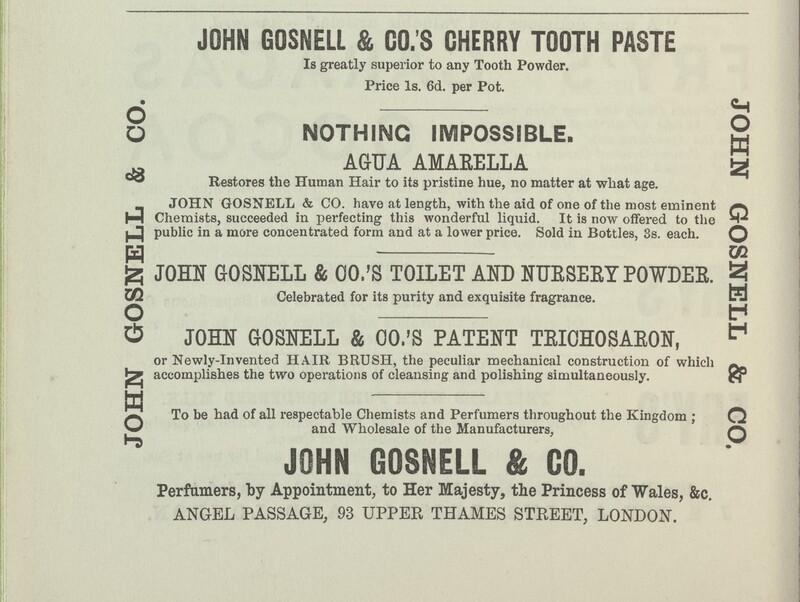
Patent language positions itself in two ways: on the invention of an entirely new product or process that arose from the work of the inventor, and, second, on the improvement of an existing product or process that permitted the creation of a distinct persona of an object, such that it was distinct from whence it originated. The “newly-invented” object, such as the patented “trichosaron” hairbrush, accomplished “two operations” simultaneously, suggesting a new model of productive use. Appearing as an advertisement in the 1871 printing of Middlemarch, we might see the corollary in Lydgate, a newly-arrived character in Book II described as being a “vigorous animal” (99) who “meant to be a unit who would make a certain amount of difference towards that spreading change which would one day tell appreciable upon the average” (101). Lydgate’s invention as a new man is reflected in his training in Paris with Pierre Charles Alexandre Louis (114), and his position that members of the medical profession charge for their services, rather than being paid for “making out long bills for draughts, boluses, and mixtures” (302), even though his colleagues in Middlemarch imply that he is “insolent, pretentious, and given to that reckless innovation for the sake of noise and show which was the essence of the charlatan” (309).
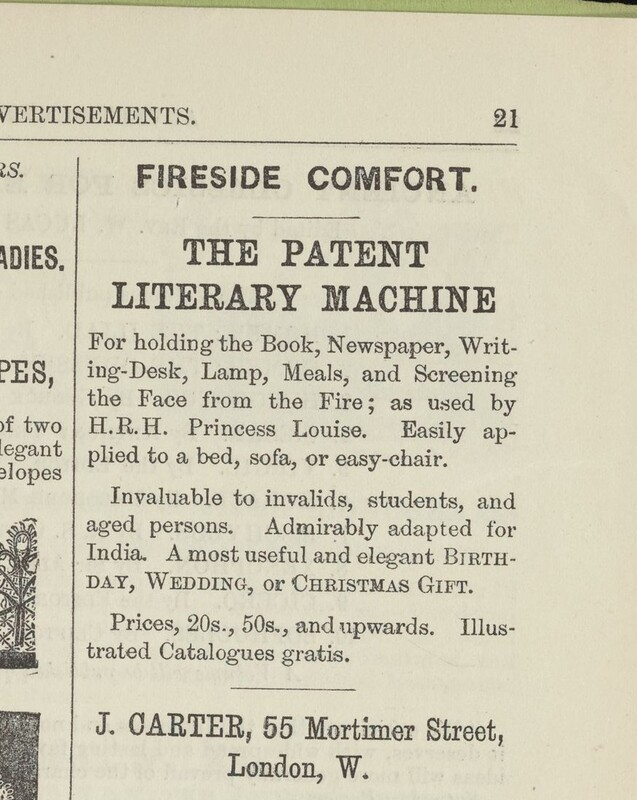
The “newness” of Victorian inventions, and the advertisements that herald the same, tends to reflect that technological innovation “proceeds as a cumulative process,” which Cantwell suggests results in industries and sectors “locking in” to a particular course of development, so that their pattern of development “is likely to change only gradually over time since a shift towards sectors in which technological opportunities are rising most rapidly may not be easy to achieve” (38). This is, sadly, reflected in Lydgate’s inability to change course over the novel: his innovative medical methods collapse in the face of overwhelming debt and social disgrace, and he leaves off his passion for infectious disease to minister to wealthy patients in London and at a continental spa, having “written a treatise on Gout,” and the narrator concludes that “he had not done what he once meant to do” (560). Even as we recognize the invention of new methods and processes in Lydgate, his so-called patent fails to result in the great changes he once envisioned. Still, though, the story of his rise and fall in Middlemarch reflects the kind of economic success and failure of patented objects: not all, unfortunately, will prove successful in the way we hope.
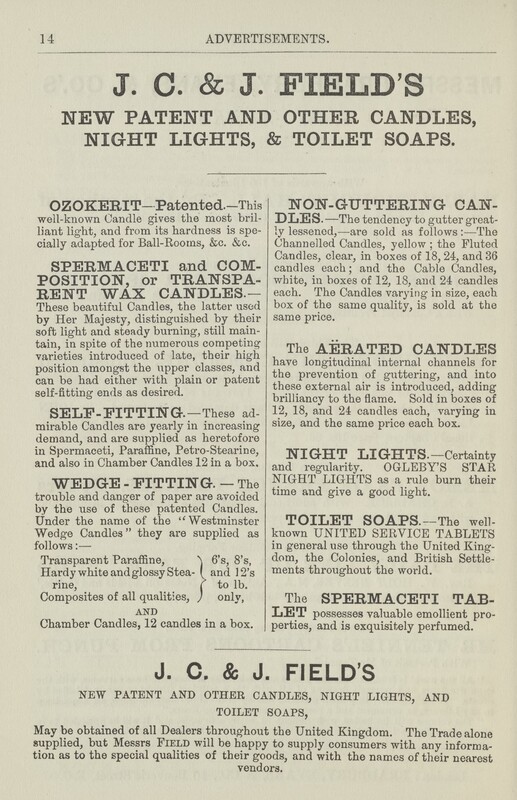
The language of patents and progress also reflect the ability of innovation to provide an improvement. Writing on Victorian patents, Clare Pettit comments that “concepts of creativity, originality, authenticity, and genius were much in everyone’s mind” (88) immediately after the Great Exhibition of 1851. The particular focus on the patent as an improvement is reflected in debates and opinion pieces from the Victorian period. Lyon Playfair, commenting on patents, remarks that “rewards for successful venture must be offered to all who have inventive faculties, in order that there may be a constant effort for improvement and progress” (58), and the Hansard records of debate on the Patent Bill in the House of Commons suggest that Victorians regarded patents as a way to provide “benefit to the country” (Wakley 1852), offering “valuable improvements” (Shelley 1858), and that theft of intellectual property should hold that “an individual was guilty of as flagrant a wrong who pirated another’s invention as the man who robbed his purse” (Carter 1852). The text of the Patent Bill amendment also reflects the value assigned to improvements: that the inventor believes they “will be of great Public Utility” (423). Lori Ann Loeb comments that in the early Victorian period, “it became popular to believe that the world could be bettered through sustained human effort and intelligence” (47). The advertisements in the 1871 and 1872 printings of Middlemarch often reflected an improvement of a product, rather than a new invention. Advertisements for patented candles, for example, do not purport to have invented a new kind of candle, but rather that they are improved to the point where a patent is needed to protect the intellectual effort that resulted in the innovation.
Within the pages of Middlemarch, characters are in the process of inventing new versions of themselves: Rosamond recasts herself as favoured daughter to become an unhappy wife, Dorothea navigates first her situation as newlywed, then as widow, and Bulstrode tries–and fails–to live as a righteous man. Within the novel, though, Fred Vincy’s rehabilitation from failed, feckless student to a respectably employed family man parallels the type of re-invention seen in the Victorian emphasis on innovation. The Fred of Book III, for example, is mired in debt, and has “assets of hopefulness” that have a “sort of gorgeous superfluity about them” (157). Having failed his examinations at school, Fred’s prospects are poor; he is unable to make any productive contribution to the public good. Indeed, he is something of a drain on resources, since Alfred Garth’s education must be delayed and Mary’s savings plundered when Caleb and Mrs. Garth resolve to loan him money for his debt. The first glimmer that Fred may be moving towards a reinvention, though, is in that moment when he feels, “for the first time something like the tooth of remorse” (170) when Mrs. Garth outlines the consequences of the loan.
It takes some time for Fred’s actions to be realistically categorized as an innovation on his previous behaviour. By Book VI, he is still worried by his “unsuccessful efforts to imagine what he was to do,” finding himself neither suited for the Church at the risk of losing Mary’s affections but also entirely unsuitable for employment (374). What happens next is the first real turn towards that improvement, when he tries to break up the assault of a railroad surveyor by a group of farmers–a selfless act. That act is recognized by Caleb Garth, who offers him the opportunity of decent employment, and suggests to him that there is the opportunity for betterment, telling him that “you are young enough to lay a foundation yet” (380). When he comes to be tested by Mr. Garth, Fred is unprepared, and he feels “an awkward movement of the heart” (383). Embarrassed by his handwriting and Mr. Garth’s correction, the narrator suggests that anybody looking into the office “might have wondered what was the drama between the indignant man of business, and the fine-looking young fellow whose blond complexion was getting rather patchy as he bit his lip with mortification” (384). Fred Vincy’s parents are equally shocked by this new employment; his mother looks at him as if “he were the subject of some baleful prophecy” (386). The reinvention–the improvement–is well at hand.
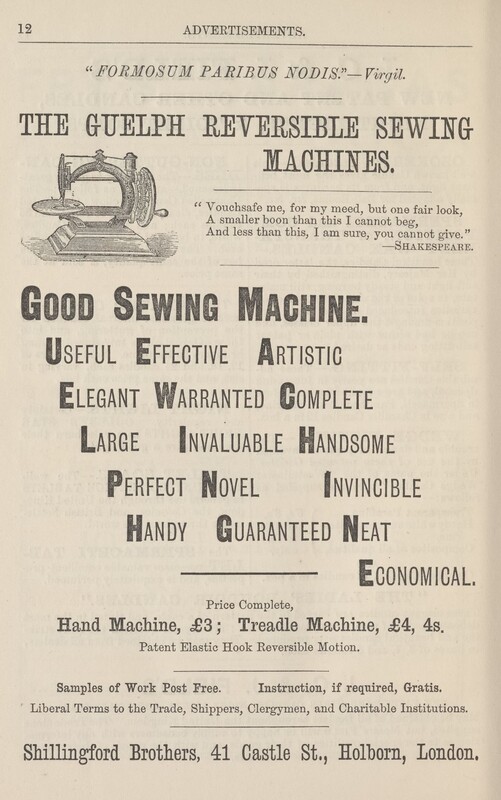
The concept of reinvention and a Victorian view of productivity is reflected in the steady flow of advertisements promising an improved material aspect of a thing, and the patent was a means to protect and reward that innovation. By the time Middlemarch was printed, Victorian England was “a prodigiously abundant society” with a keen view of a standard of living that could be measured “by counting the number of goods and articles that people consumed” (Richards 119). Abundance is protected by patents, designed to ensure that the benefits of intellectual property belong to those inventors and innovators. Turning back to parliamentary debates, we find an MP commenting that it would be a “hard thing that a poor man of inventive genius, if he discovered something that would raise his reputation” were not able to secure a patent, and that “every facility should be given, especially in a country like this, to persons who brought out inventions” (Wakley 1852). The implication in the context of our reading of Middlemarch as a text, and our reading of the language of patents that flows through advertisements appearing in its pages, is the positive regard the inventor is held in. Fred Vincy, now working to improve himself, is to be given the management of Stone Court. Mr. Garth, speaking to Mary, comments that “he’ll be steady and saving,” (556) and when Mary relays the plan to Fred, he tells her, “Oh, I could be a tremendously good fellow then, Mary, and we could be married directly” (557). Fred’s self-improvement is a kind of innovation that a Victorian reader might recognize as a more inventive version of himself, and one that is sufficiently improved so as to be made new again. By the end of Middlemarch, we are told that Fred has “remained unswervingly steady,” having settled happily with Mary and settled down to the task of being a “theoretic and practical farmer” of some distinction (558). The useless is made useful, and more than that, he is productive and economical, and destined to live in “white-haired placidity” (559) with Mary.
Reading Middlemarch through the lens of the language of patents offers us the opportunity to examine the narratives of improvement and invention that form a contextual link to its advertisements, but also to the way we understand characters and story. Our contemporary reading may suffer overly from the language of progress and innovation that ripple and thrum through all aspects of modern life, but understanding that the pace of innovation and improvement is not measurably different from that of the Victorians give us a sense of how pervasive the language is, and how it comes to find itself written into the story. Ironically, the Victorians were falling victim to a productivity slowdown that mirrors our own, though for different reasons: the climacteric notation that has long been thought to have been Edwardian is, in fact, a Victorian turning point, with a sustained fall in labour productivity growth that was characterized by “sluggish development” and slow adoption of new technologies, capital market failures taking place with excessive foreign investment, and inadequate national systems to invest in human capital, research and development, and slowdowns in export demand growth by 1890 (Craft and Mills 743-744). What was occurring in the Victorian economic context may have placed greater emphasis on the necessity for improvement through innovation and invention, much as we are seeing now with the growth of collision spaces and accelerators designed to inculcate entrepreneurial mindsets where they might flourish. The patterns of invention and improvement seen in characters like Lydgate and Fred Vincy suggest that the wider patterns of patent reform and protections reflect preoccupation with the driving force of capitalism and the need to be new, or, at the very least, be better. How will the stories of our own era be read, set next to the advertisements washing over us? As Eliot’s narrator says, the “growing good of the world is partly dependent on unhistoric acts,” (563), and perhaps in these words, we find the uncomfortable echo of the beat of a familiar drum.
Works Cited
Britain. Parliament. House of Commons. Debates (Hansard). 15 Parl, 5 Session, No. 122, vol 122 cc1221-34, 27 May 1852. https://api.parliament.uk/historic-hansard/commons/1852/may/27/patent-law-amendment-bill.
Britain. Parliament. House of Commons. Debates (Hansard). 17 Parl, 2 Session, No. 122 vol 150, cc516-20, 12 May 1858. https://api.parliament.uk/historic-hansard/commons/1858/may/12/second-reading-1.
Cantwell, John. “Historical Trends in International Patterns of Technological Innovation.” James Foreman-Peck, editor. New Perspectives on the Late Victorian Economy. Cambridge University Press, 1991, pp. 37-72.
Crafts, Nicholas and Mills, Terence C. “Sooner than you think: the Pre-1914 UK Productivity Slowdown was Victorian not Edwardian.” European Review of Economic History, no. 24, 2020, pp. 736-748.
Eliot, George. Middlemarch. 1872. Edited by Ronjaunee Chatterjee. W. W. Norton & Company, 2024.
Loeb, Lori Ann. Consuming Angels: Advertising and Victorian Women. Oxford University Press, 1994.
Pettitt, Clare. Patent Inventions – Intellectual Property and the Victorian Novel. Oxford University Press, 2004.
Playfair, Lyon. “On Patents and the New Patent Bill.” 1877. Tatiana Kontou, Victoria Mills, Deborah Wynn, Louisa Yates, eds. Victorian Material Culture, Vol 4, pp. 55-59.
Ravenstein, Ernst Georg. Census of the British Isles, 1871. The Birthplaces of the People and the Laws of Migration. Trübner & Co., 1876. The Making of the Modern World, link.gale.com/apps/doc/U0113047629/MOME?u=ucalgary&sid=bookmark-MOME&xid=3a20fb6b&pg=5.
Richards, Thomas. The Commodity Culture of Victorian England: Advertising and Spectacle, 1851-1914. Stanford University Press, 1990.
Statues of the United Kingdom of Great Britain and Ireland, 15 & 16th Parliament. Patent Law Amendment Act. 1852. London: Her Majesty’s Printers, 1852.
United Kingdom Intellectual Property Office. IPO Facts and Figures: Patents, trade mark, designs and hearings 2024.” 2024, https://www.gov.uk/government/statistics/facts-and-figures-patents-trade-marks-designs-and-hearings-2024/facts-and-figures-patents-trade-marks-designs-and-hearings.
United Kingdom Intellectual Property Office. Patent applications filed and patents granted each year 1852 to 1915. 2014, https://webarchive.nationalarchives.gov.uk/ukgwa/20140603184215/http://www.ipo.gov.uk/types/patent/p-about/p-whatis/p-oldnumbers/p-oldnumbers-1852.htm.
United Kingdom Office for National Statistics. Population estimates for England and Wales: mid-2024. 30 July 2025, https://www.ons.gov.uk/peoplepopulationandcommunity/populationandmigration/populationestimates/bulletins/populationestimatesforenglandandwales/mid2024.
United Kingdom Office for National Statistics. Population estimates for the UK, England and Wales, Scotland and Northern Ireland: mid-2015. 23 June 2016, https://www.ons.gov.uk/peoplepopulationandcommunity/populationandmigration/populationestimates/bulletins/annualmidyearpopulationestimates/mid2015.