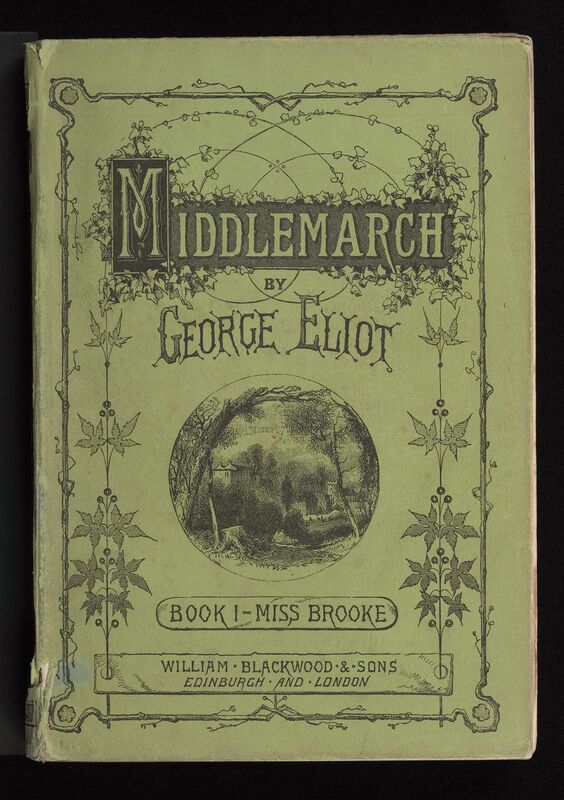
Book 1, Miss Brooke, Middlemarch by George Eliot
Middlemarch, Book 1 "Miss Brooke," William Blackwood and Sons, Edinburgh and London, 1871. New York Public Library Digital Collections.
Introduction: "A World in Itself": The Metropolitan Reader and the Provincial Marriage Plot
Middlemarch is set between 1829 and 1832, but its first readers encountered the novel in 1871, a moment shaped by industrialized commodity culture and shifting forms of gendered subjectivity. Eliot’s retrospective setting is itself significant: the provincial world she depicts is already receding for the reader who encounters it, its formations legible as historical rather than present. As Gillian Beer argues, the advertisements sandwiched between the installments constitute a paratext structurally formative of the novel’s reading conditions (17–21). The figures those advertisements address, bodies to be modified, heightened, and brought into consumer circulation, are not the same women and men the novel represents. The reader of 1871 is positioned between two historical formations, and it is this gap the paratextual advertisements make legible. This exhibit argues that the advertisements do not merely frame the novel but produce a different kind of reader, one already shaped by consumer culture, and that from this position the marriage plot reveals a shared instability in both feminine desire and masculine respectability.
Kate Flint shows that a material frame runs through the novel rather than around it, with the reader’s physiology entrained by the shared environment text and objects jointly construct (65–68). Elaine Freedgood identifies the internal mechanism: Eliot’s narrator standardizes response and stabilizes meaning, rendering people legible in advance (115–117). As Lysack argues, consumer culture complicates desire by emphasizing the agencies women obtain through consumption, whereby pleasure becomes lived subjectivity rather than its opposite (5–11). With this notion of authentic pleasure in mind, the social formation assumed by the novel’s provincial world, what Upchurch describes as a properly constituted family that “could insulate itself from outside intrusions” through marriage, diligent work, and institutional sanction (25), is precisely what the reader of 1871 stands outside of. The advertisements address a body consumer culture has begun to mobilize, and this exhibit reads the marriage plot from that vantage point.
Following Sedgwick's account of the homosocial system in Between Men and Epistemology of the Closet, alongside Braun's account of the emergent femme fatale, this exhibit attends to the way commodity culture and novelistic form press against one another across the serialization, and to what that pressure makes visible for the metropolitan reader of 1871. Dorothea Brooke is not a failed Saint Teresa but an erotic force whose capacity for feeling exceeds what the marriage plot and the Angel ideal can absorb. For a man of Casaubon’s class and historical moment, the available forms of respectable life, the clergy, scholarship, and late marriage, organize desire into a muted tradition of presentation so complete that it appears as absence. Dorothea’s erotic force and Casaubon’s silenced desire are not separate phenomena but opposite expressions of the same homosocial arrangement. The containment of feminine subjectivity and the performance of masculine respectability are mutually dependent, and the paratextual advertisements illuminate the conditions under which both are already under pressure.
What this exhibit traces are not two parallel stories of repression but a single rupture: the suppression of feminine desire through the marriage plot generates the conditions of its own undoing, which in turn destabilizes the masculine respectability that depends on feminine containment. Hints of that emergence appear in the dissonance of an unconsummated honeymoon, in a woman standing in Roman light before a sleeping Ariadne, and in a man in the Vatican Library sustaining a life organized around not feeling. The paratextual advertisements do not only contextualize these scenes; they illuminate the conditions under which the honeymoon, the Ariadne, and the Vatican Library are already readable as part of the same story. Perhaps the metropolitan London reader was always in on the secret.

Frame 1 — "Rome: Her Pope and King": The Institutional Closet and the Pre-Categorical Silence
"Rome is still the Eternal City," the advertisement declares, but what it offers is not Rome as place. It offers Rome as figure. She "wielded" power; she "excites" attention. The city is structurally feminized, no longer sovereign but all the more compelling for it. Authority has shifted registers: Rome no longer commands; she attracts. The advertisement moves quickly into mediation, through The Graphic, Sydney Hall's engravings, and artists and authors of ability, those for whom Rome's aesthetic and classical registers are already legible. Rome becomes something to be seen through representation, already an image before it is a place. "Universal interest" does not describe; it assumes. The reader is expected to know what Rome holds. Middlemarch places Casaubon there. He qualifies. He knows. And he spends the honeymoon in the library.
Before Rome is reached in the narrative, Eliot has already prepared what it will expose. Casaubon is introduced not through action but through interior report, his thinking folding back on itself, insulation masquerading as intellectual seriousness. Desire is not absent but displaced: Casaubon concludes that "the poets had much exaggerated the force of masculine passion" (53), attributing desire to literary tradition and managing it as a textual problem rather than a bodily one. Lady Chettam's observation cuts through before Rome begins: Casaubon has been "drying up faster since the engagement" (63). What Casaubon experiences as moderation, the world reads as depletion. Sedgwick's Epistemology of the Closet offers the vocabulary for that withdrawal: closetedness, she writes, is "a performance initiated by the speech act of a silence… that accrues particularity by fits and starts in relation to the discourse that surrounds and differentially constitutes it" (3). Casaubon does not inhabit the modern closet; he inhabits what it will be constructed from, a pre-categorical moment in which "the gender of object choice" has not yet crystallized into stable identity formations (3). His condition is not repression within an established identity, but a structure that has not yet acquired the language through which it can be recognized.
Upchurch identifies the social formation within which Casaubon is performing: "Men of all classes were judged by the same yardstick of character, which involved criteria such as standing in the community, respectability of occupation, and responsibility to family" (33). For Casaubon, the late marriage to Dorothea is precisely that performance, not a romantic choice but a fulfillment of the yardstick, the responsible family man completing the expected form. Eliot makes the calculation visible in Casaubon's own interiority: "Instead of getting a soft fence against the cold, shadowy, unappreciative audience of his life, had he only given it a more substantial presence?" (140). Dorothea is not a wife in any affective sense. She is the fence required, a structure meant to secure what would otherwise remain exposed. Braun argues that the mid-Victorian femme fatale serves as "a means of holding desire in check and monitoring its existence beyond purely rational expression and comprehension" (51). Conventionally, this function is applied to Dorothea as the dangerous desiring woman being contained. The evidence Eliot supplies points the other way: Casaubon expects the marriage to cost him nothing beyond its public form. What he does not anticipate is watching Dorothea become what he cannot, and watching Ladislaw, younger, cosmopolitan, funded by Casaubon himself, claim what the institutional cover permanently forecloses. This reading inverts the conventional application: the marriage does not contain Dorothea. It contains Casaubon through her.
That inversion is what the Vatican Library makes visible. Sussman identifies the institutional logic: "even in writers who present the all-male world of the monastery not as a utopia but as a prison, we see a deep if often covert apprehension about bourgeois marriage sapping male energy and domesticity vitiating male creative potency" (5). The Vatican Library is Casaubon's monastery-prison, a scholarly institution that is both cover and cage: "lost among small closets and winding stairs… with his taper stuck before him he forgot the absence of windows, and in bitter manuscript remarks on other men's notions about solar deities, he had become indifferent to the sunlight" (137). Here, intellectual labor functions not as production but as enclosure, sustaining the appearance of scholarly purpose while insulating Casaubon from lived demands. In Between Men, Sedgwick argues that "in erotic rivalry, the bond that links the two rivals is as intense and potent as the bond that links either of the rivals to the beloved" (21). Casaubon's violence toward Ladislaw, expressed through the will that disinherits Dorothea if she marries him, is that bond in its only available institutional form. The codicil does not secure Dorothea. It registers the intensity of a rivalry that cannot otherwise be articulated. Dorothea is the conduit. The bond is between the men.
Rome removes the provincial architecture that kept the arrangement functioning. When Dorothea senses something is wrong, she does not confront it but turns toward the window, where "the sun had lately pierced the grey" (53). Where Casaubon explains, Dorothea shifts into perception. Standing beside the Reclining Ariadne, that figure who "lies in marble voluptuousness of her beauty, the drapery folding around her with a petal-like ease and tenderness" (131), a metropolitan eye sees Dorothea as "beauty in its breathing life, with the consciousness of Christian centuries in its bosom" (121). What is subterranean in Dorothea is not primarily intellectual but erotic, a form of sensual knowledge Braun identifies as what "the form of the Victorian novel exposes and expands" (50), made visible to a gaze the provincial world does not possess. Rome traces, in Eliot's language, "the suppressed transitions which unite all contrasts" (134). The advertisement alongside these chapters illuminates the pressure those transitions exert on a social order structured to contain them.
The culture of 1871 does not yet have a name for what the metropolitan eye sees in Dorothea, and in the small closets and winding stairs of the Vatican Library, Casaubon has no name for what he has organized his life around not feeling through his production of “A Key to All Mythologies”. The Victorian homosocial order is holding. But the suppressed transitions are already pressing against its arrangements from within.
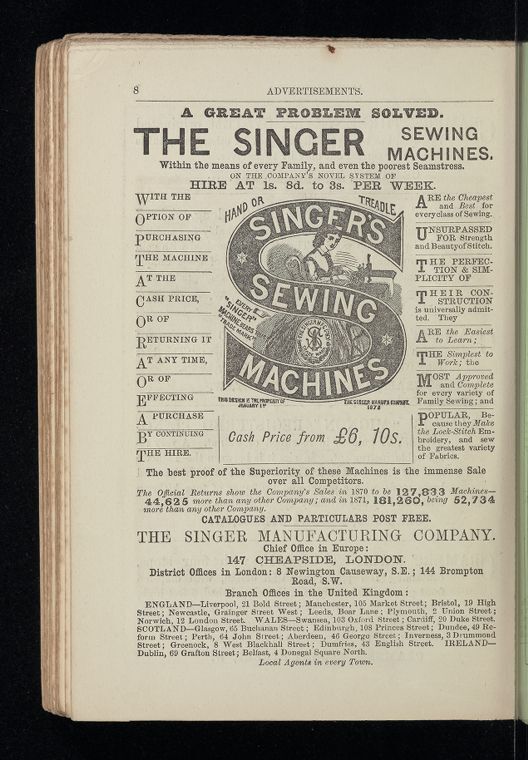
Frame 2 — “A Great Problem Solved”: The Ruptured Social Fabric and the Rising Femme Fatale
“Within the means of every Family, and even the poorest Seamstress.” The Singer Sewing Machine advertisement at the end of Book 6 does not simply address a consumer. It describes one. “Unsurpassed for strength and beauty of stitch.” “The simplest to work.” “Most approved and complete for every variety of family sewing.” Each adjective does double work, describing the machine and the ideal feminine subject simultaneously: simple, approved, complete, perfect. The Singer is not selling a product to a woman. It is producing a woman in the language of the product, the Angel of the House rendered as industrial commodity at six pounds ten shillings. But the advertisement does something more precise: it addresses a woman who can intervene, mend, and compose her own trajectories, who can size her own alterations. On the same pages sits a novel whose women are, one by one, doing exactly that. The book is titled “The Widow and the Wife.” Casaubon is dead. The great problem the Singer claims to solve is precisely the problem the novel’s structure has spent six books making unsolvable.
Ladislaw sees what the marriage was for before the Singer names it. Casaubon married Dorothea to acquire what the institutional cover foreclosed. Lysack describes the feminine subject addressed by consumer culture as one whose everyday practices extend her “into the future of the text” through “constitutive expansive subjectivity” (107). Casaubon recognizes that subjectivity in Dorothea but cannot claim it. She becomes the muse, the monitor, the soft fence through whom the desire the muted tradition of presentation organized into silence could be held and contemplated at a distance. Confronted with the image of Casaubon “groping after his mouldy futilities,” Ladislaw experiences something he cannot quite place: “this sudden picture stirred him with a sort of comic disgust… For an instant he felt that the struggle was causing a queer contortion of his mobile features, but with a good effort he resolved it into nothing more offensive than a merry smile” (142). The “queer contortion” resolves into a smile, but the strain remains. The word “groping” does what the novel cannot say directly, marking a disjunction between Casaubon’s intellectual posture and the obscured terrain of his desire. Casaubon gropes in the dark while Dorothea stands in the light, and Ladislaw metabolizes that recognition into a socially acceptable expression. The erotic triangle Sedgwick maps in Between Men is visible in the contortion itself.
Dorothea, meanwhile, begins to see through the function she was assigned. Eliot describes her emerging from moral stupidity: “it had been easier to her to imagine how she would devote herself to Mr Casaubon, and become wise and strong in his strength and wisdom, than to conceive with that distinctness which is no longer reflection but feeling… that he had an equivalent centre of self, whence the lights and shadows must always fall with a certain difference” (146). What becomes available here is not a new idea but a different mode of apprehension: Casaubon is no longer a portal but a subject. With that shift, the muse function collapses into Dorothea’s subjectivity, and with it dissolves Casaubon’s access to the erotic ease he married her to contain. When Dorothea raises the subject of Ladislaw, Casaubon responds with the most controlled sentence he speaks: “I had a duty towards him,” laying his hand on Dorothea’s in conscientious acceptance of her caress, “but with a glance which he could not hinder from being uneasy” (156). The statement performs composure while the glance betrays strain. “Dorothea did not mention Will again” (156). The silence accrues particularity. The closet holds.
But the closet holds only as long as Casaubon is alive to perform it. The codicil disinheriting Dorothea if she marries Ladislaw is the closet’s final performance, the rivalry bond in its only available institutional form. The will is not about Dorothea. It is about Ladislaw, the man Casaubon funded and watched become what the institutional cover prevented him from being. Ladislaw inhabits the looser sexual realities the Grand Tour makes available, a world Casaubon paid to organize but could never enter (51). The codicil is defeat dressed in institutional authority. It fails. In this sense, Casaubon’s marriage to Dorothea was never only about containing her. It was also about stabilizing him. The desire the marriage monitored was not only Dorothea’s. It was also Casaubon’s. With his death, the monitoring ends.
The Singer arrives in the ruins of this failure. But the Singer’s answer is not Dorothea’s. Lysack is precise: women’s spending “functions not as a simple emancipatory practice but as a disruptive element within the masculine economies” that disengages women from identification with the commodity form (107). Dorothea does not want the machine. She wants what it was produced to contain. “I want so little,” she tells Ladislaw, “no new clothes, and I will learn what everything costs.” (546) To learn what everything costs is to size her own alterations entirely, to claim the expansive subjectivity Casaubon could see in her and could never follow her into. Rosamond’s refusal shows that this loosening exceeds Dorothea’s case and registers more broadly across the novel’s gendered arrangements: “In all future conversations on the subject, Rosamond was mildly certain that the ride had made no difference…” (396). Here, the body insists on its own version of events, indifferent to narrative correction. What unravels in Book 6 is not a web but a costume, a social fabric that dressed these women in roles the Victorian homosocial order required and that the Singer promises only to refit more precisely.
The femme fatale does not destroy. She refuses. She was the figure through whom pre-categorical desire could be expressed as institutional respectability. When Dorothea walks away with the desire the closet managed, she takes with her the erotic ease Casaubon could see but never embody. She gets what he wanted. In getting it, she loosens the structure that depended on her containment. The Singer cannot solve that problem. What loosens around the emergent femme fatale also loosens around the cosmopolitan dandy.
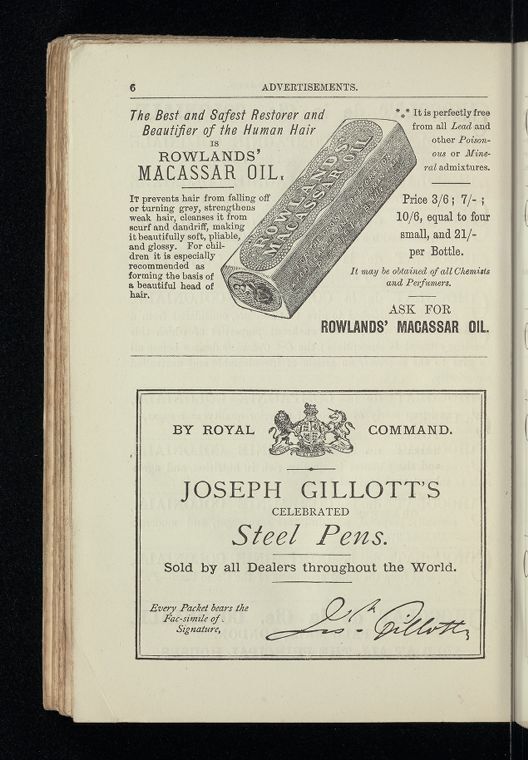
Frame 3 — “Rowlands’ Macassar Oil”: The Institutional Collapse and the Cosmopolitan Dandy
“The best and safest restorer and beautifier of the human hair.” Rowlands’ Macassar Oil appears at the end of Book 7, after Casaubon’s death, available at all chemists and perfumers throughout the kingdom. It is a London product, addressing a body that tends itself, that cultivates its surface without institutional sanction. The body this advertisement produces is not the institutional man of Frame 1. It is the cosmopolitan dandy, an aestheticized, self-tending male body that will become, by the fin de siècle, a recognizable cultural type. The femme fatale always had access to this address: the Odonto, perfumes, and beauty products of the earlier installments speak to a body that can be modified, heightened, and brought into desiring circulation. The Macassar Oil extends that address to the male body after the institutional cover collapses. In the same column sits Joseph Gillott’s steel pens, “By Royal Command,” the instrument of masculine scholarly authority beneath the beauty product. The institutional pen and the grooming oil. The old cover and the new figure. The advertisement does not announce the transition. It stages it by placing the two side by side.
The institutional collapse Middlemarch documents is not only Casaubon’s. Fred Vincy refuses the clergy, rejecting the institutional cover that would have organized his life within the same monastery-prison that destroyed Casaubon. “Mary,” he begins, “I am a good-for-nothing blackguard” (173). To name oneself a blackguard is at least to know what one is; Casaubon never reaches that point. Brooke sees Casaubon’s trap with accidental precision: “A clergyman is tied a little tight… To this mental estate mapped out a quarter of a century before, to sensibilities thus fenced in, Mr Casaubon had thought of annexing happiness” (191). The language is spatial and restrictive: mapped out, fenced in. The silence is also a cartographic problem, a man living inside a map drawn before he knew what territory he inhabited. Rome offers a glimpse of unmapped territory, “which made the mind flexible with constant comparison and saved you from seeing the world’s ages as a set of box-like partitions without vital connexion” (147), but Casaubon cannot take it. As Upchurch argues, the age of reform produced not simply new laws but new ways of organizing the relationship between the individual and the forms available to him, forms that for men of Casaubon’s class and vocation were both enabling and confining (12). The reform Middlemarch anticipates is not only parliamentary but the slow dissolution of the institutional architecture through which masculine respectability organized desire into silence.
What the Macassar Oil addresses is the body that steps out of that architecture. Where Casaubon could only access the cosmopolitan ease of the femme fatale by acquiring her through marriage, the cosmopolitan dandy accesses it directly, through the surface, through aesthetics, through self-presentation. This is the same register commodity culture has long offered the female consumer and now extends to the male body without institutional mediation. Dellamora tracks this emergence in Victorian Sexual Dissidence: the figure begins to practice what Dellamora describes, following Foucault, as 'an aesthetic care of the self,' a mode of being at once aesthetic, ethical, and invested in sexual practices between men (6). Upchurch documents what upper-class British men on the Grand Tour already knew: that in Naples “love between men is so frequent that one never expects even the boldest demands to be refused” (51). Ladislaw reaches that world. Casaubon pays for him to do so and retreats to the Vatican Library. The Macassar Oil produces the cosmopolitan dandy in the ruins of that retreat, nascent in the groomed, self-tending body the advertisement addresses, twenty-four years before Oscar Wilde’s trials make him fully legible. The dandy goes to London. Casaubon went to Rome and found the Vatican Library.
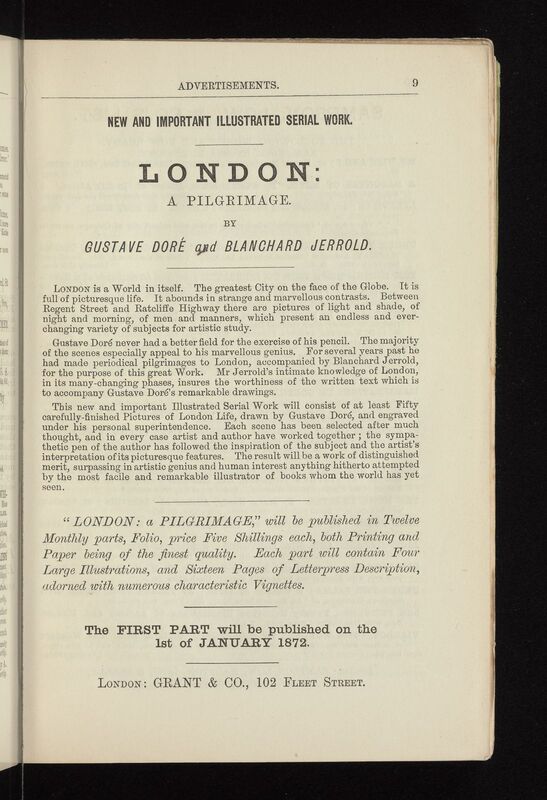
Conclusion — “London: A Pilgrimage”: The Destination That Always Was
Return to Book 1. 'Miss Brooke.' On page 9 of its advertisements, before Dorothea has spoken a word, before Casaubon has appeared, before Rome has been imagined, London: A Pilgrimage announces itself. 'London is a World in itself. The greatest City on the face of the Globe. It abounds in strange and marvellous contrasts.' The metropolitan destination is named in the margins before the provincial story begins. On the same pages, the narrator introduces Dorothea with a question that is also a pointed verdict: 'And how should Dorothea not marry? Nothing could hinder it but her love of extremes, and her insistence on regulating life according to notions which might cause a wary man to hesitate' (7). The wary man hesitates. The provincial world manages. But the advertisement does not cooperate. London is already there on page 9 while the provincial world states its terms by framing Miss Brooke. Braun traces the legislative materialization of what Middlemarch encodes structurally, reading the movement toward the Matrimonial Causes Act of 1857 and the Married Women's Property Act of 1883 as the slow formal recognition that the coupled repressions the novel traces are not sustainable (6). The metropolitan reader of 1871 stands precisely at that threshold, not yet inside the reform, but already shaped by the consumer culture the advertisements address, already positioned to feel the pressure the provincial world is working to contain. The advertisements do not only contextualize the novel. They position the reader outside it, close enough to follow the marriage plot, distant enough to see through it. The metropolitan reader was already positioned to take pleasure in the recognition.
Works Cited
Beer, Gillian. “What’s Not in Middlemarch.” Middlemarch in the Twenty-First Century, edited by Karen Chase, Oxford University Press, 2006, pp. 14–28.
Braun, Heather. The Rise and Fall of the Femme Fatale in British Literature, 1790-1910. Fairleigh Dickinson University Press, 2012.
Dellamora, Richard. Victorian Sexual Dissidence. University of Chicago Press, 1999.
Eliot, George. Middlemarch. Edited by Ronjaunee Chatterjee, Norton Critical Edition, W. W. Norton, 2024.
Flint, Kate. “The Materiality of Middlemarch.” Middlemarch in the Twenty-First Century, edited by Karen Chase, Oxford University Press, 2006, pp. 65–78.
Lysack, Krista. Come Buy, Come Buy: Shopping and the Culture of Consumption in Victorian Women’s Writing. Ohio University Press, 2008.
Sedgwick, Eve Kosofsky. Between Men: English Literature and Male Homosocial Desire. 30th anniversary edition, with a new foreword by Wayne Koestenbaum, Columbia University Press, 2016.
Sedgwick, Eve Kosofsky. Epistemology of the Closet. Updated with a new preface, University of California Press, 2008.
Sussman, Herbert L. Victorian Masculinities: Manhood and Masculine Poetics in Early Victorian Literature and Art. Cambridge University Press, 1995.
Upchurch, Charles. Before Wilde: Sex between Men in Britain’s Age of Reform. University of California Press, 2009.