Sewing Frame
A book can be viewed as a set of moving parts. The spine of the book helps the book cover open, close, and hold multiple pieces of paper that can all flip and move without coming off of the spine. One aspect of bookbinding is concerned with how well the book can do this movement and what the book is made for; before the introduction of the sewing frame, when bookbinders sewed on the board of the book, the spines of books were becoming concave, and the strain of opening and closing the book was too much for the sewn on threads to handle (Szirmai 95). The main problem was the strength of the book cover attachment, or the boards were attached to the paper (95); the method used to attach it was simply was not strong enough (95).
The sewing frame is an object that helps solve this problem. The sewing frame is a Western Romanesque introduction from the Middle Ages that began to show use in the twelfth century (Szirmai 140). The sewing frame is an object that is used for suspending sewing supports in the air (140); sewing supports are tough threads that get sewn onto the spine of the pages, which are "critical to the durability of the spine" (Conroy 12). The sewing frame allows the pages of the book to be sewn together before the cover of the book is attached, whereas in the past, they had to sew supports into the cover board before sewing the rest of the book (Szirmai 140). Sewing these supports onto the pages without a sewing frame was generally considered to be impossible (171), or it is at least will produce a cranky bookbind that is sure to breakdown quicker than if a frame were used (Conroy 20).
The sewing frame is used for several methods of bookbinding sewing, which sometimes differ between cultures, such as bypass sewing in Mexico (Romero 395). But the introduction of the sewing frame allows for the kettle-stitch, which is the strongest type of bookbinding stitch (Zaehnsdorf 22). Additionallly, the sewing frame in the photos of this page was made in the Kettle Stitch Bindery in Calgary, Alberta. The term itself has nothing to do with kettles, as it is a corruption of "catch-up stitch," because the sewing catches each section of the supports in succession and sews around the cord (22). This sewing method takes 3-4 times longer than an ordinary sewing method, so it was used for books that required more strength (24). For example, a book opened for constant reference or daily use would be kettle stitched, whereas a book that will sit on a shelf more often would not (24).
This is all to say that the intended functions of the sewing frame highlight the problem with bookbinding sewing before the frame was invented. That is, the tension of sewing at the spine need to be consistent throughout each cord, which is what sewing supports are for, but it is difficult without a tool to manage it for the sewer (Conroy 19).
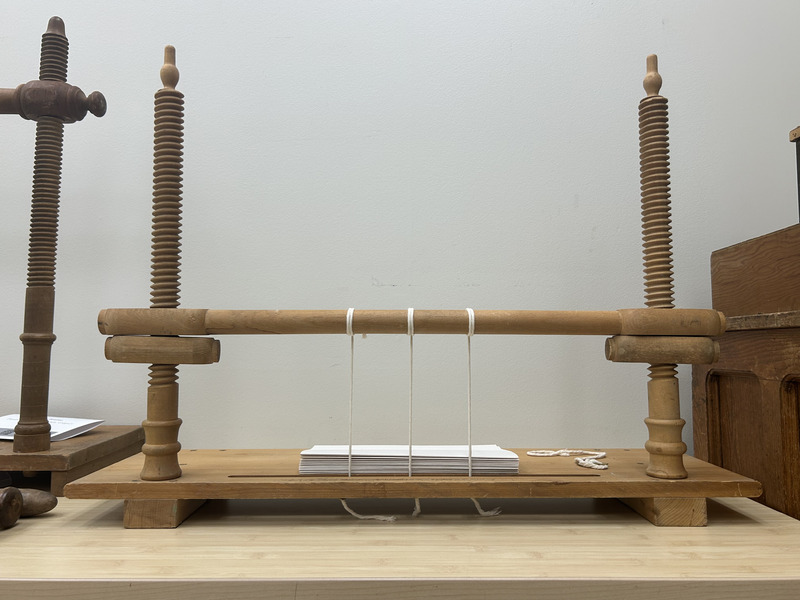
Full View of Sewing Frame
This is a wide shot of the full sewing frame, sometimes called the "sewing table" or "sewing press" (Zaehnsdorf 20). To be considered a full sewing frame, it must contain a bed, two screws, a beam/crossbar, and threads (20). The threads on the crossbar are called lay cords (20). The pieces of wood underneath the crossbar are called nuts, which help tighten the bar height and keep it in place (Hasluck 42).
The amount of fastened lay cords are usually five (Hasluck 20), but it is possible to successfully sew a book with a frame with no less than three cords, usually for smaller books up to 6 by 9 inches in size (Banister 80). This can be seen in the picture, as there are only three lay cords.
In bookbinding, the sewing frame is used after the pages of the book has been beaten and collated, which is to make the pages lie close together so it can be bound; this is so it can be sown on as if it were one solid object rather than multiple (Hasluck 38). After it is collated, the spine of the pages are moved to touch the lay cords and enter their saw channels—created if kettle-stitching—and are sewn onto with the help of the sewing frame (41).
Additionally, it is possible to sew more than one book at a time using the sewing frame (46). As long as the books are of similar sizes, the sewer can sew them all and keep their binds separate as long as the lay cords are kept long enough to cut and leave 2.54cm between each book (47).

Close-up of Strung up Threads on Sewing Frame
This is a close-up of the lay cords on the crossbar. These lay cords are acting as sewing supports.
When setting up lay cords, it is best to make the cords all the same size (Banister 81). That way, when strung up on the crossbar, they all get the same amount of tension; the sewing frame is meant to control the tension of sewing supports and keep them all of similar tension (Conroy 19). Ultimately, tension is the important part of bookbind sewing, and is the reason books being sewn off frame were becoming concave; if the cords are strung up too tight on the sewing frame, the spine on the book will become concave from the pull (19), but tension too loose will result in a spine that moves around too much, resulting in a flabby spine and a low quality bind (19). For example, a bind with excessive tension on the supports will produce a book unable to close properly without the use of clasps (21). Additionally, finely adjusting the tensions of the support in post is impossible, and sewing off the sewing frame will "normally cause cranky action and premature breakdown" (20) because of inconsistent tension (20).
The ideal way to string up lay cords is to screw them up tightly, but loose enough to allow them to move freely backwards or forwards (Zaehnsorf 21).
There are ways to fix a flabby spine (21), and certain types of sewing will try and disguise uneven tension of supports (20), but a fix can be avoided entirely by getting the correct tension for a quality bind via the sewing frame. The problems of bookbinding prior to sewing supports and the sewing frame (Szirmai 95) can still be achieved when the tools are not used correctly.
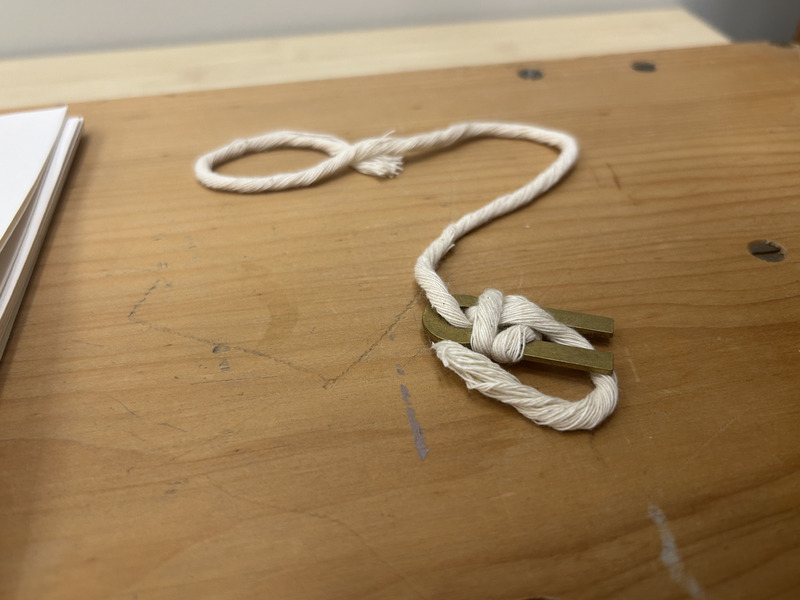
Close-up of Sewing Frame Key
This photo shows a lay cord off of the crossbar with its key tied to it, which is the metal in this image. Keys can be made of brass, copper, aluminium, or hardwood (Banister 80) and are 0.15cm in height (81). The keys are virtually invisible when looking at the frame from a full angle, as shown in the image prior, but that is because they are snugly placed at the bottom of the sewing frame bed when in use. The lay cord is tied to the key by twisting the end of it around the key twice, an then sewing a half hitch onto it (Zaehnsdorf 21). These keys are essential to keep the lay cords tight onto the sewing frame and keep their tension (Banister 80), which mentioned previously, is the most important part of the sewing supports.
Lay cords were usually made of alum-tawed skin, and this material for supports were preferred in Europe in the 16th century (Miller 393). However, many different materials were used for lay cords, which all have a different stiffness and different thicknesses (Conroy 15), which makes a difference in binding since these materials might differ in stretchiness (15). For example, tawed pig skin is more pliable and durable than cord, but tawed skin pliability differs depending on the animal and the age of that animal (15). Additionally, silk can also be used (Zaehnsdorf 23).
Furthermore, bookbinding tape can be used on a sewing frame in a similar fashion to cords; bookbinding tape also has its own key, called the tape key (Banister 59).

Wooden Screw of Sewing Frame, Including Wooden Nuts
This is a close up of the parts of the screw. The crossbar has a hole to attach to the screw, but the wooden plank underneath the crossbar, the nut, is what is screwable (Hasluck 42). When setting up the sewing frame for use, the screws of the frame have to be screwed up to ensure the proper height of the thread an also make sure that the lay cords become taut (42). They are then tightened to make sure that they do not give when the cords are being stretched (42), because if they were to give, the threads would lose their tension and ruin the quality of the sew.
The screws allow for the height to be adjustable, which can be helpful when sewing more than one book at a time; its a time saver to sew as many books as the sewing frame can hold (Hasluck 42).
When the bookblock is fully sewn, the nuts get slackened so that the lay cords can be detached from the keys and the bar (Zaehnsdorf 24). Sometimes, when the bar is dropped or slackened, if the tension on the cords were too tight, the threads on the bookblock will contract and cause a concave spine (19).
Overall, the sewing frame is an evolution of bookbinding techniques that happened gradually throughout the Middle Ages (Szirmai 140) and stayed as a standard piece of bookbinding equipment for centuries (Husby 460). Furthermore, the European Influence of sewing supports meant that other cultures were also adopting sewing frames and sewing supports, such as Mexico binderies obtaining sewing frames (Romero 388) and adopting the same alum-tawed supports with it (393).
The sewing frame matters because it strives to make higher quality bookbindings that help books and their covers more reliably be a working set of movable parts. One can imagine that a flimsily bound book, or a book that is unable to be closed, would actively get in the way of the book being an object to be used as it was intended. A book that is incorrectly bound and made for everyday use will break down fast; paper is vulnerable to breaking when under too much tension (Conroy 5), which would hamper a reader's ability to read the contents of the page. It is not enough for the contents of the book to be sufficient—the book as a working, movable object must also work as intended to help the book be used as intended.
Works Cited
Bainbridge, Abigail, and Abigail Bainbridge. “European Bindings.” Conservation of Books, edited by Abigail Bainbridge, 1st ed., vol. 1, Routledge, 2023, pp. 170–213, https://doi.org/10.4324/9781003162674-8.
Banister, Manly. Bookbinding as a Handcraft. Sterling, 1975.
Brassington, William Salt. A History of the Art of Bookbinding: With some Account of the Books of the Ancients. London: Elliot Stock, 62, Paternoster Row, 1894.
Conroy, Tom. “The Movement of the Book Spine”, The Book and Paper Group Annual, 1987, pp. 1-30.
Hasluck, Paul Nooncree. Bookbinding, with Numerous Engravings and Diagrams. London: Cassell and Company, 1907.
Romero, Martha E. “European Influence in the Binding of Mexican Printed Books of the Sixteenth Century”, Suave Mechanicals: Essays on the History of Bookbinding, edited by Miller, Julia, 2013, pp. 384-400.
Scott Husby. “‘Anatomy of the Book: Sewing Structures,.’” The Princeton University Library Chronicle, vol. 60, no. 3, 1999, pp. 459–62. JSTOR, https://doi.org/10.25290/prinunivlibrchro.60.3.0459. Accessed 8 June 2026.
Szirmai, J. A. The Archaeology of Medieval Bookbinding. Ashgate, 2001.
Zaehnsdorf, Joseph William. The Art of Bookbinding, London: George Bell & Sons York Street Covent Garden, 1880.